


New Cambridge History of the English Language

Introduction
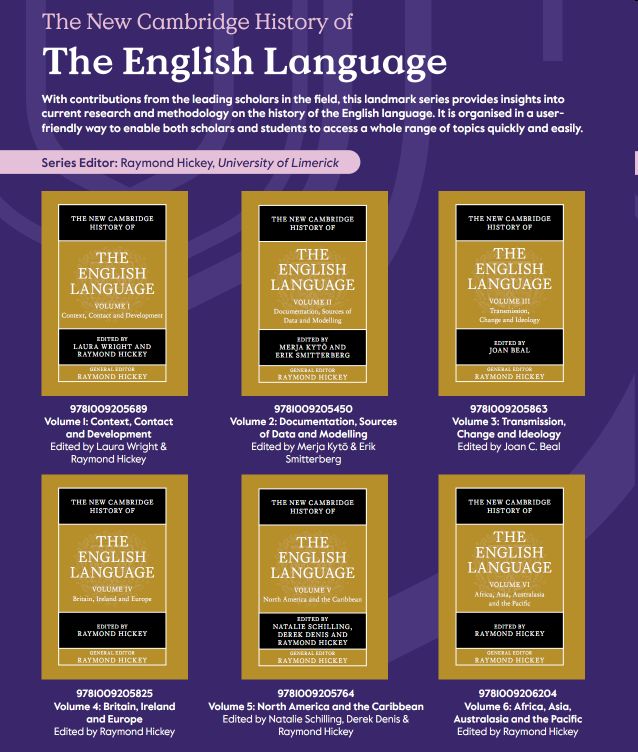
Volume 1 Volume 2
Volume 3 Volume 4
Volume 5 Volume 6
References
View presentation on the new history.
Note. In several sections of the present website references to chapters in the new history have been added. These are intended to be used as starting points for anyone wishing to delve more deeply into a particular subject. A full list of all the contributions can be found here:
The organisation of the new history is largely by topic (Vols. I-III) and then by area (Vols. IV-VI). This differs from that of the original Cambridge History of the English Language which was largely chronological (Vols. I-IV) and then by area (Vol. V-VI).
When planning the new history, the first question was: what does one understand by history? For the current work, history is understood as a dynamic process; it is continuously evolving, beginning deep in the past and reaching down to and including the present. Importantly, the history of English is not a straight line from the earliest documents in English to the present-day standard of British English. The image I have chosen to visualise this conception of history is that of a braided river which consists of several streams, which come together, move apart and come together again.
Approaches to the History of English Most traditional treatments of the history of English have divided it into three large chronological blocks as follows:
There are certain disadvantages associated with such a division, above all the frequent implication that the language evolved according to such compartmentalisation. It addition, the tripartite division has Early Modern English as its third section, which with the passage of time became increasingly longer. This fact, along with other considerations, let to the following further division:
This has allowed scholars to concentrate on essential changes - in language and attitudes - which occurred in the eighteenth and nineteenth centuries. The essential concerns of the late modern period are reflected in many of the contributions in the new history.
Organisation of the new history of the English language
After checking university syllabuses for the history of English across the world, it became clear that practically no universities offered full-term courses using the traditional divisions into chronological segments, e.g. Old or Middle English. Rather the universities have topic-oriented courses, e.g. historical pragmatics, historical corpus linguistics, sociolinguistics and the history of English, etc. So the decision was made to have chapters of about 20-25 pages in the new history. These could then be used as reading material, say for a particular week, within courses dedicated to various historical topics.
The ‘Long View’ perspective
Seven detailed chapters While choosing the format of single 20-25 page chapters, it was recognised that overviews of linguistic levels and areas over the entire history of English would also be called for. To this end there are, in Volume 1, a series of seven chapters, which provide overviews of the respective fields from the earliest attestations of English down to the present day. The areas covered are the following:
 All contributions in the New Cambridge History of the English Language (Microsoft Word file).
Volume 1
Context, contact and development
Volume 2
Documentation, data and modelling
Volume 3
Transmission, change and ideology
Volume 4
Britain, Ireland and Europe
Volume 5
North America and the Caribbean
Volume 6
Africa, Asia, Australasia and the Pacific (2 books)
Part 1
English in Africa and the South Atlantic
Part 2
English in Asia, Australasia and the Pacific
Volume 1
The Beginnings to 1066 (ed. Richard M. Hogg, 1992)
Volume 2
1066-1476 (ed. Nicholas Blake,1992)
Volume 3
1476-1776 (ed. Roger Lass, 1999)
Volume 4
1776-1997 (ed. Suzanne Romaine, 1998)
Volume 5
English in Britain and Overseas - Origins and Dvelopment (ed. Robert Burchfield, 1994)
Volume 6
English in North America (ed. John Algeo, 2001)
A view of history
Label
Time
Old English
450-1100
Middle English
1100-1500
Early Modern English
1500-present
Early Modern English
1500-1800
Late Modern English
1800- present
Phonology
Morphology
Syntax
Semantics
Pragmatics
Sociolinguistics
Onomastics
Although detailed treatments of a range of authors from various periods are not given there are nonetheless three chapters dedicated to the English language as found in (i) the Beowulf manuscript, (ii) the works of Geoffrey Chaucer and (iii) the works of William Shakespeare.
Present research trends
The research paradigm 'Language Variation and Change' has informed much recent research into the history of English. This approach examines minute instances of variation to discern trajectories of language change.
Methodologies
With the advent of powerful computers in the late 1980s and 1990s linguists began collecting large amounts of data - known as text corpora - and began using these increasingly in their research. This research avenue has been greatly expanded in the present century.
Sociolinguistics: Networks and communities of practice
The role of networks and communities of practice in social organisation and also in language maintenance and/or change has been increasingly recognised and its insights have been applied to the history of English.
New approaches: Women's voices in the history of English
Women authors have been active in many spheres of society over the centuries and have contributed to the textual record of English. There are early religious works by female writers and towards the modern period we find women dramatists and novelists with distinct voices and unique styles of language. Women have also left behind many collections of letters and works criticising practices of their time, notably slavery and colonialism.
New approaches: Orality in historical documents
Scholars began discovering new paths to explore in the history of English. One of these was examining the relationship of colloquial spoken language (shown in texts) to formal written language.
New approaches: The rise of standard English
This is a topic which has garnered much scholarly attention in the past few decades with a focus on how prescriptivism arose as a practice, above all in the nineteenth-century. This is a practice in which some people tell others how they should speak and write, all the while condemning their native mode of language. It is associated with a number key authors, like Thomas Sheridan, John Walker and Robert Lowth, and with the codification of standard English in the eighteenth and nineteenth centuries.
New sources of data
Historical newspapers, emigrant letters and court depositions, such as those of defendants at the Old Bailey in London over a considerable time span (1740-1913), are among the many new sources of historical English, which offer unique insights into vernacular English at various periods.
Furthermore, functional, usage-based and psycholinguistic approaches to language change are considered in dedicated chapters as are grammaticalisation and Construction Grammar, i.e. new models of grammar have arisen as alternatives to the established approaches of generative grammar.
Historical pragmatics
This field covers a number of topics, such as how norms of politeness (and impoliteness) changed over the centuries. More generally, it also involves the means by which speakers organise their conversations with others, i.e. how they use language in concrete exchanges with others.
Varieties of English in the twenty-first century
Africa and Asia have the largest growth in numbers of English speakers and this is likely to increase dramatically in the course of the present century with consequences in terms of the global diversification of English and the future history of the language. For this reason there are many chapters in the new history dedicated to varieties of English in Africa, Asia, Australasia and the Pacific.
Reassessments
A number of issues in the history of English have been reassessed for the new history. An example of this is the contact between speakers of Celtic and Germanic in the Old English period which may well be responsible for certain structures in later English, such as the use of personal pronouns with parts of the body, e.g. Mind you head; My elbow is sore.
Redressing certain imbalances
Lastly it should be mentioned that the new history has tried to redress a number of perceived imbalances in the original history. For instance, there were previously only two chapters on English in Canada - this has now be increased to seven - and there was only one on English in South Africa - this has now been increased to four. Furthermore, the coverage of English in Asia (South, South-East and East) and the Pacific area has been greatly increased.
| General Editor’s Introduction: English, Englishes and the English Language (Raymond Hickey) |
| Introduction to Vol. I (Laura Wright and Raymond Hickey) |
| I The context of English |
| 1. The Indo-European framework (Donald Ringe) |
| 2. English in its Germanic surrounding (Wayne Harbert) |
| 3. Language development in the Old English period (Julia Fernández Cuesta) |
| 4. The geography of English in England (Merja Steenroos) |
| 5. Philology and the history of English (Laura Wright and Raymond Hickey) |
| II Contact and external influences |
| 6. Early contact with Celtic (Raymond Hickey) |
| 7. Latin in the early history of English (Olga Timofeeva) |
| 8. The Scandinavian period (Richard Dance and Sarah Pons-Sanz) |
| 9. Anglo-Norman, its dictionary and the study of English vocabulary (Geert de Wilde) |
| 10. Code-switching and language mixing (Herbert Schendl) |
| 11. Early standardisation (Louise Sylvester) |
| 12. Neoclassical borrowings: ‘Hard Words’ in English (Letizia Vezzosi and Luca Baratta) |
| 13. Typological reorientation in the history of English (Marion Elenbaas) |
| III The long view by levels of language |
| 14. Historical phonology (Donka Minkova) |
| 15. Historical morphology (Elżbieta Adamczyk) |
| 16. Historical syntax (Bettelou Los) |
| 17. Historical semantics (Kathryn Allan) |
| 18. Historical pragmatics (Andreas Jucker) |
| 19. Historical sociolinguistics (Terttu Nevalainen and Tanja Säily) |
| 20. Historical onomastics (Richard Coates) |
| Appendix: Recommended reading |

Volume 2: Documentation, data and modelling
.jpg)
Editors: Merja Kytö and Erk Smitterberg (Uppsala)
| General Editor’s Introduction: English, Englishes and the English Language (Raymond Hickey) |
| Introduction to Vol. II (Merja Kytö, Erk Smitterberg and Raymond Hickey) |
| I The textual record |
| 1. Early English inscriptions, glosses and documents (Jeremy Smith) |
| 2. Vernacular speech in writing (Colette Moore) |
| 3. Orality in the history of English (Matylda Włodarczyk) |
| 4. The story of English orthography, and its analysis (Jan Čermák and Ondrej Tichý) |
| 5. English manuscript traditions (Christine Wallis) |
| 6. Text editions and the philological tradition (Matti Peikola) |
| 7. The history of books and printing (Sarah Noonan) |
| 8. Historical corpora of English (Merja Kytö and Erik Smitterberg) |
| 9. Historical thesauri of English (Marc Alexander and Fraser Dallachy) |
| 10. Assessing loanwords and other borrowed elements in the English lexicon (Philip Durkin) |
| 11. Historical slang (Jonathon Green) |
| 12. Phraseology: From phrasal verbs to proverbs (Gabriele Knappe) |
| 13. The language of dialect writing (Javier Ruano-García) |
| II Lighthouse works and authors |
| 14. Beowulf as a source text for archaic features (Robert Fulk) |
| 15. Language use in Chaucer’s Canterbury Tales (Simon Horobin) |
| 16. Shakespeare’s language (Jonathan Culpeper and Sean Murphy) |
| III Genre and medium in the record |
| 17. Grammatical treatises in early English (Annina Seiler and Nicole Studer-Juho) |
| 18. History writing (Claudia Claridge) |
| 19. The language of religious texts (Tanja Kohnen and Thomas Kohnen) |
| 20. The language of courtroom documents (Terry Walker) |
| 21. Medical and scientific writing (Irma Taavitsainen and Turo Hiltunen) |
| 22. The language of newspapers (Birte Bös and Nicholas Brownlees) |
| 23. ‘Bad data’: The case for early audio records (Raymond Hickey) |
| 24. Ego documents in the history of English (Anita Auer and Raymond Hickey) |
| 25. Personal letters in a community context (Samuli Kaislaniemi and Anni Sairio) |
| 26. Women’s voices in the history of English (Carol Percy) |
| IV Modelling the record: methods and theories |
| 27. Quantitative methods and the history of English (Axel Bohmann and Lotte Sommerer) |
| 28. Generative accounts of change (Cynthia Allen) |
| 29. Functional accounts of change (Hubert Cuyckens) |
| 30. Grammaticalisation (Andrew D. M. Smith) |
| 31. Cognitive approaches to the history of English (Alexander Bergs) |
| 32. Construction Grammar and English historical linguistics (Martin Hilpert) |
| 33. Psycholinguistic perspectives on language change (Marianne Hundt, Simone E. Pfenninger and Sandra Mollin) |
| Appendix: List of corpora and other electronic resources |
| General Editor’s Introduction: English, Englishes and the English Language (Raymond Hickey) |
| Introduction to Vol. III (Joan C. Beal and Raymond Hickey) |
| I The transmission of English |
| 1. Dictionaries in the history of English (John Considine) |
| 2. Writing grammars for English (Ingrid Tieken-Boon van Ostade) |
| 3. Speech representation in the history of English (Peter Grund) |
| 4. The history of English in the digital age (Caroline Tagg and Melanie Evans) |
| 5. Internet resources for the history of English (Ayumi Miura) |
| II Tracking change in the history of English |
| 6. Spelling practices and emergent standard writing in late Middle English (Juan Camilo Conde Silvestre and Juan Manuel Hernández Campoy) |
| 7. Phonological change (Gjertrud Flermoen Stenbrenden) |
| 8. Applying historical phonology (David Crystal) |
| 9. The emerging phonological standard (Lynda Mugglestone) |
| 10. The history of R in English (Raymond Hickey) |
| 11. The system of clausal complementation (Hendrik de Smet) |
| 12. Tense and aspect in the history of English (Teresa Fanego) |
| 13. Developments in the passive construction (Peter Petré) |
| 14. Adverbs in the history of English (Ursula Lenker) |
| 15. The story of English negation (Gabriella Mazzon) |
| 16. Dative and genitive variability in the history of English (Anette Rosenbach) |
| 17. Relativisation (Cristina Suárez Gómez) |
| 18. Recent grammatical change in English (Jill Bowie and Bas Aarts) |
| 19. The history of English registers (Nuria Yáñez Bouza and Javier Pérez Guerra) |
| 20. The history of semantic theory (Susan Fitzmaurice and Seth Mehl) |
| 21. The development of pragmatic markers (Laurel Brinton) |
| III Ideology, society and the history of English |
| 22. The ideology of Standard English (Lesley Milroy) |
| 23. The discourse of prescriptivism (Don Chapman) |
| 24. English dictionaries from the eighteenth century onwards (Charlotte Brewer) |
| 25. Networks, coalitions and language change (Marina Dossena) |
| 26. Communities of practice in the history of English (Joanna Kopaczyk) |
| 27. Indexicality, enregisterment and the history of English (Joan Beal and Paul Cooper) |
| General Editor’s Introduction: English, Englishes and the English Language (Raymond Hickey) |
| Introduction to Vol. IV (Raymond Hickey) |
| I Language Variation and Change |
| 1. Sociolinguistic sources of change (Devyani Sharma) |
| 2. Life-span changes (Isabelle Buchstaller and Suzanne Evans-Wagner) |
| 3. Supraregional varieties, standards and vernaculars (Raymond Hickey) |
| 4. Historical divisions and perceptual dialectology (Chris Montgomery) |
| II English in England |
| 5. The traditional dialects of England and the history of English (Warren Maguire) |
| 6. The history of Received Pronunciation (Anne H. Fabricius) |
| 7. Early London English (Laura Wright) |
| 8. The recent history of London English (Susan Fox) |
| 9. English in the South-West of England (Susanne Wagner) |
| 10. English in East Anglia (David Britain and Robert Potter) |
| 11. English in the Midlands (Esther Asprey and Natalie Braber) |
| 12. English in Merseyside (Anthony Grant and Raymond Hickey) |
| 13. English in Tyneside (Adam Mearns) |
| III English in Wales |
| 14. The history of English in Wales (Robert Penhallurick) |
| IV English in Scotland |
| 15. The history of Scots (Joanna Kopaczyk) |
| 16. The lexicography of Scots (Maggie Scott) |
| 17. Scots and Scottish Standard English (Jane Stuart-Smith and Rachel Macdonald) |
| 18. English in Orkney and Shetland (Peter Sundkvist) |
| IV English in Ireland |
| 19. History and dffusion of Irish English (Raymond Hickey) |
| 20. Southern Irish English (Raymond Hickey) |
| 21. Northern Irish English (Raymond Hickey) |
| IV English in Europe |
| 22. English in the Channel Islands (Heinrich Ramisch) |
| 23. English in Gibraltar (Cristina Suárez-Gómez and Elena Seoane) |
| 24. English in Malta (Alexandra Vella and Sarah Grech) |
| 25. English in Cyprus (Sarah Buschfeld and Manuela Vida-Mannl) |
| General Editor’s Introduction: English, Englishes and the English Language (Raymond Hickey) |
| Introduction to Vol. V (Natalie Schilling, Derek Denis and Raymond Hickey) |
| I The United States |
| 1. Language change and the history of American English (Walt Wolfram) |
| 2. The dialectology of Anglo-American English (Natalie Schilling) |
| 3. The roots and development of New England English (James N. Stanford) |
| 4. The history of the Midland-Northern boundary (Matthew J. Gordon) |
| 5. The spread of English westwards (Valerie Fridland and Tyler Kendall) |
| 6. American English in the City:The case of Pittsburgh (Barbara Johnstone) |
| 7. New York and Baltimore (Aidan Malanoski and Michael Newman) |
| 8. English in the southern United States (Becky Childs and Paul E. Reed) |
| 9. Contact forms of American English (Cristopher Font-Santiago and Joseph Salmons) |
| 10. The roots of African American English (Tracey L. Weldon) |
| 11. The Great Migration and regional variation in the speech of African Americans (Charlie Farrington) |
| 12. Urban African American English (Nicole Holliday) |
| 13. Rural African Amercian English (Patricia Cukor-Avila) |
| 14. Puerto Rican English (Rosa E. Guzzardo Tamargo) |
| 15. The English of Americans of Mexican and Central American heritage (Erik R. Thomas) |
| II Canada |
| 16. Anglophone settlement and the creation of Canadian English (Charles Boberg) |
| 17. The lexis of Canadian English: History, structure, and social correlations (Stefan Dollinger) |
| 18. Ontario English: Loyalists and beyond (Derek Denis, Bridget Jankowski and Sali A. Tagliamonte) |
| 19. The Prairies and West of Canada (Alex D’Arcy and Nicole Rosen) |
| 20. Canadian Maritime English: Solidarity and resistance, yeah (Matt Hunt Gardner) |
| 21. English in Newfoundland (William Kirwin, rev. Sandra Clarke and Raymond Hickey) |
| 22. English as a minority language in Quebec: A (Socio)linguistic Aperçu (Shana Poplack) |
| III The Caribbean |
| 23. Early English-lexifier creole in the circum-Caribbean area (Norval Smith) |
| 24. The Caribbean anglophone contact varieties: Creoles and koinés (Jeffrey Williams) |
| 25. English in Jamaica - Between local and foreign (Sylvia Kouwenberg) |
| 26. The anglophone Caribbean Rim (Angela Bartens) |
| 27. North American - Caribbean linguistic connections (Stephanie Hackert) |
| General Editor’s Introduction: English, Englishes and the English Language (Raymond Hickey) |
| Introduction to Vol. VI (Raymond Hickey) |
| I The spread of English overseas |
| 1. Transported English in the colonial period (Raymond Hickey) |
| 2. Modelling the formation and developmental trajectories of varieties of English (Edgar Schneider) |
| 3. Towards a history of World Englishes (Rajend Mesthrie) |
| 4. English as a second and foreign language (Andy Kirkpatrick) |
| 5. Pidgins and creoles in the history of English (John McWhorter) |
| II Africa |
| West Africa |
| 6. English and Krio in Sierra Leone (Kofi Yakpo, Malcolm Awadajin Finney and Saida Bangura) |
| 7. English in Liberia (John Victor Singler) |
| 8. English in Ghana (Thorsten Brato) |
| 9. English in Nigeria (Ulrike Gut and Foluke Unuabonah) |
| 10. English in Cameroon (Hans-Georg Wolf and Eric Anchimbe) |
| East Africa |
| 11. English in Kenya and Tanzania (Josef Schmied) |
| 12. English in Uganda, Rwanda, Burundi, the Democratic Republic of Congo and South Sudan (Christiane Meierkord, Bebwa Isingoma and Anne Marie Kagwesage) |
| Southern Africa |
| 13. South Africa I – The anglophone settlement of South Africa (Ian Bekker and Kara Schultz) |
| 14. South Africa II – English of the black population of South Africa (Rajend Mesthrie and Bertus van Rooy) |
| 15. South Africa III – English of Afrikaans speakers (Bertus van Rooy and Ronel Wasserman) |
| 16. South Africa IV – English of the Indian population of South Africa (Rajend Mesthrie) |
| 17. English in Namibia (Sarah Buschfeld) |
| 18. English in Zimbabwe (Susan Fitzmaurice) |
| III The South Atlantic |
| 19. South Atlantic English (Daniel Schreier) |
| 20. The English of the Falkland Islands (David Britain, Hannah Hedegard and Andrea Sudbury) |
| IV Asia |
| South Asia |
| 21. English in India (Robert Fuchs and Claudia Lange) |
| 22. English in Pakistan (Muhammad Shakir and Dagmar Deuber) |
| 23. Sri Lankan English (Tobias Bernaisch) |
| East Asia |
| 24. English in mainland China (Kingsley Bolton and Wei Zhang) |
| 25. Hong Kong English: From colonial to postcolonial English (Kingsley Bolton) |
| 26. English in Korea (Sofia Rüdiger) |
| 27. English in Japan (Toshiko Yamaguchi) |
| South-East Asia |
| 28. English in Singapore (Jakob Leimgruber) |
| 29. English in Brunei and Malaysia (David Deterding and Nur Raihan Mohamad) |
| 30. Englishes within and beyond the Philippines (Isabel Pefianco Martín and Julius C. Martinez) |
| V Australasia |
| Australia |
| 31. English in Australia (Kate Burridge and Pam Peters) |
| 32. Australian Creoles (Sally Dixon) |
| 33. Australian Aboriginal English (Celeste Rodríguez Louro, Glenys Collard and Madeleine Clews) |
| New Zealand |
| 34. English in New Zealand (Lynn Clark, Andreea S. Calude and Jennifer Hay) |
| 35. Maori and Pasifika Englishes in New Zealand (Anita Szakay and Andy Gibson) |
| VI The Pacific |
| 36. Pidgin and English in Hawai‘i (James Grama, Michelle Kamigaki Baron and Katie Drager) |
| 37. English in Micronesia (David Britain and Kazuko Matsumoto) |
| 38. Melanesian Pidgin, Tok Pisin and English in Papua New Guinea (Craig Volker) |
| 39. English in the South Pacific (Carolin Biewer) |
.jpg)
.jpg)
.jpg)
.jpg)
.jpg)
.jpg)