

| Theme Guide for Irish English |
 News
Archives
Corpora
Contact studies
Downloads
News
Archives
Corpora
Contact studies
Downloads
Diaspora Transportation Ulster-Scots Immigration
Sociolinguistics Literature / Media Standard Irish English
Phonology Syntax Vocabulary Pragmatics
Discourse analysis Teaching / Second Language Acquisition
Bilingualism / Code-switching Language attitudes / Perception
The Irish English Network is an internet service for all those interested in the English language in Ireland – students and scholars alike, curated by Anne Barron, University of Lüneburg, Germany. The field of Irish English studies is a robust and vibrant area of research and is the focus of a range of scholars, convincingly documented by the active participation at the conferences New Perspectives on Irish English (2010- , bianually) at which many participants from around the world report on their work on English in Ireland.
| News |

After previous conferences in Dublin (2x), Limerick, Bergen, Postdam, Vienna, Cork, Cáceres, the series New Perspectives on Irish English 9 is continuing with the latest in the series, New Perspectives on Irish English 9, hosted by Marino Institute of Education, Dublin in May 2026, organised by Fergus ’Dwyer, Stephen Lucek and Bettina Migge. Future meetings are planned for Bremen (Germany, 2028) and Lorient (Brittany, 2030).

| Archives |
The National Museums, Northern Ireland have a project designed to maintain audio records of English as spoken in Ireland, beginning with the Tape-recorded Survey of Hiberno-English Speech, begun in the 1970s and reaching down to the present. It is linked to the Sound Archive at this museum which houses about 15,000 audio recordings.
.jpg)
| Corpora |

A number of new corpora, both recently completed and currently being compiled, have been announced recently. Among these are the following.
ICE-Ireland (the Irish component of the International Corpus of English), a corpus of over a million words consisting of both written texts and transcribed speech broadly representing supraregional Irish English from both the north and the south of Ireland. ICE-Ireland was compiled by John Kirk (Queen’s University, Belfast) and Jeffrey L. Kallen (Trinity College Dublin). (See also the section on Standard Irish English).

A Corpus of Irish English Correspondence (CORIECOR) is a new corpus compiled by Carolina Amador-Moreno (University of Extremadura) and Kevin McCafferty (University of Bergen). There is a visually oriented version of this corpus available at CORVIZ Project.
In addition to the above one could mention the Limerick Corpus of Irish English (compiled by a team at the University of Limerick) which has been used for a number of linguistic investigations. The corpus is synchronically oriented and one of its primary aims is to document pragmatic features of present-day Irish English. More information on this can now be found on Sketch Engine https://www.sketchengine.eu/limerick-corpus-of-irish-english/.
There is a also a corpus of largely historical material available on the CD of the book Corpus Presenter. Software for Language Analysis (Amsterdam: John Benjamins, 2003) by Raymond Hickey. See http://www.raymondhickey.com/index_(CP).html for more details.
Mention should be made here of The Inter-Varietal Applied Corpus Studies (IVACS) research centre, hosted by the Mary Immaculate College/University of Limerick, which ‘brings together researchers whose goal it is to add to the description of language variation in context and to explore how the outcomes of this empirical research might apply to pedagogy’. It is accessible at http://www.mic.ul.ie/ivacs/.
| Contact studies |

The field of contact studies is still very vibrant. Among the recent concerns of scholars in this field have been the following:
1) The relationship of contact-induced language change to universals of language change (Peter Siemund, University of Hamburg) and the nature of the contact process (Donald Winford, Ohio State University). See the book Winford, Donald 2003. An Introduction to Contact Linguistics. Oxford and Malden, MA: Blackwell. (cf. section ‘Irish English’, pp. 237-241).
2) The role of contact in the increase in frequency for structures present in both source and target languages, e.g. the continuous form (Markku Filppula, University of Eastern Finland). On a more general level, Markku Filppula has done much research into the influence of Celtic on English during the history of the latter language, see the book Filppula, Markku, Juhani Klemola and Heli Paulasto 2008. English and Celtic in contact. London: Routledge.
_small.jpg)
3) The interplay of different levels of language in contact situations, e.g. prosody and syntax (Raymond Hickey, Essen). See also Raymond Hickey (ed.) 2020. The Handbook of Language Contact. Second edition. Malden, MA: Wiley-Blackwell.
-small.jpg)
| Downloads |

The following items are overview articles of English in Ireland by the compiler of this website. They can be downloaded as individual PDF files by clicking on one or more of the titles.
Present and Future Horizons for Irish English
Language Change among Young People
| Diaspora |
New dimensions of the Irish diaspora have been investigated recently. For instance, Carolina Amador-Moreno has reported on the Irish emigrants to Argentina in the late nineteenth century and has uncovered recordings of fourth-generation speakers of Irish English from Argentina. Their language is a useful source of information on north-Leinster and Co. Wexford English as it was spoken in the nineteenth century.
.jpg)
| Transportation |

Information on historical forms of Irish English can be found in the letters which emigrants wrote back home in the eighteenth and nineteenth centuries. Work is ongoing on collecting such letters and analysing them linguistically. The following scholars are particularly active in this field.
Kevin McCafferty (University of Bergen) and Carolina Amador-Moreno (University of Extremadura), compilation of CORIECOR: a corpus of Irish-English correspondence c. 1700-1900 with later analysis. Much of the material has been gleaned from the emigration letters deposited at the Ulster American Folk Park in Co. Omagh.

Further information about emigration from Ireland in the past few centuries can be found in the followed comprehensive study.
.jpg)
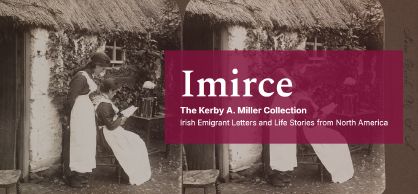
The University of Galway has a comprehensive on-going project in which letters by Irish emigrants to North America, both the United States and Canada, are being digitised and archived at the university. The initial impetus was to curate the letters collected by the American scholar Kerby Miller, but it has been expanded to act as a digital repository for Irish emigrant letters in general.
| Ulster-Scots |
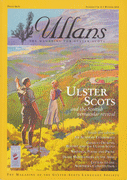

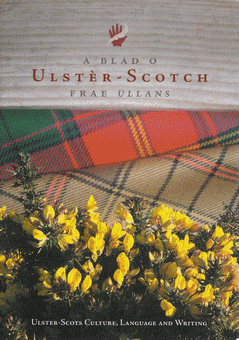
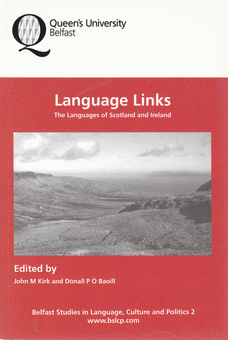
During the eighteenth century about a quarter of a million people left either Ulster or Lowland Scotland for the United States. These are the ancestors of the Scotch-Irish section of the present-day US population. Considerable work on this emigration and the linguistic connections between Ulster and America was done by Michael Montgomery. Dictionary work on the forms of English spoken by the descendants of seventeenth century emigrants from Lowland Scotland to Ulster has also been produced, above all by James Fenton (see the section on Vocabulary). More recent work on Ulster-Scots has been done by Göran Wolf, University of Göttingen.
_small.gif)
| Immigration |

Work on the linguistic integration of recent immigrants is being carried on by Vera Regan (School of Languages and Literature, University College Dublin, now retired) and her associates. They have investigated the language of Polish immigrants to Ireland, from older ones who came in the early 1990s to more recent ones who arrived in the 2000s after the accession of Poland to the European Union. Among Vera Regan’s colleagues in this work are Catríona Ní Chasaide and Niamh Nestor.


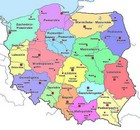
Karen P. Corrigan is another scholar who has carried out major research into the (Northern) Irish English as used by first and second generation migrants to Ireland in the past few decades.
.jpg)
| Sociolinguistics |

Most work which focuses on the pronunciation of Irish English is done within what could be broadly termed a variationist framework. This work concentrates at the moment on language use in cities, though in principle sociolinguistic study of rural dialects in Ireland is equally possible.
Aspects of language use in a number of Irish cities are currently under investigation. The pronunciation of Dublin English has been examined by John Lonergan (formerly University College Dublin) as has English in Drogheda (a town some 50 kilometres north of Dublin) by Raya Kalaldeh (formerly Trinity College Dublin) and another on intonation in Ulster by Amelie Dorn (formerly Trinity College Dublin, University of Vienna). The specifics of rising intonation in declaratives in Belfast English has been investigated by Jennifer Sullivan (formerly University College Dublin).
English in Galway city is the focus of attention for two PhDs by young German scholars, Arne Peters (University of Bremen) and Katrin Sell (formerly University of Bamberg), both of whom presented results from their data analysis at conferences in the New Perspectives on Irish English series. The thesis by Arne Peters has been published (see references update to the Source Book for Irish English).
A volume on sociolinguistics in Ireland was published in 2016 by Palgrave Macmillan under the editorship of Raymond Hickey as was the volume on Irish identies (together with Carolina Amador-Moreno) in 2020 by de Gruyter Mouton.
.jpg)
.jpg)
A number of recent sociolinguistic investigations, centred on Dublin and/or the new pronuncation of Irish English, have appeared adding significantly to the sociolinguistics of Irish English.
.jpg)
.jpg)
.jpg)
| Literature / Media |


The language of literature has always been a concern among scholars investigating English in Ireland. The language of established writers like Jonathan Swift, James Joyce, John Millington Synge, Sean O’Casey have been examined by many scholars in the twentieth century (see the many references A Source Book for Irish English which deal with this issue).
There have also been recent studies in this field, for instance Carolina Amador-Moreno’s examination of the language of the early novels of the Donegal novelist Patrick McGill (An Analysis of Hiberno-English in the Early Novels of Patrick MacGill. Bilingualism and Language Shift from Irish to English in County Donegal. Lewiston, NY: The Edwin Mellen Press, 2006).
Another scholar working in this area is Kevin McCafferty who has done original research on the northern Irish writer William Carleton (see references in the update to the Source Book for Irish English).
A further book in this area is Raymond Hickey (ed.) Varieties of English in Writing. The Written Word as Linguistic Evidence. Amsterdam: John Benjamins, 2010.

In the area of film a notable publication has been the PhD thesis by Shane Walshe which examined the use of Irish English in films.
.jpg)
| Standard Irish English |

Since the advent of ICE-Ireland (the Irish component of the International Corpus of English) there has been renewed interest in the question of what constitutes Standard Irish English and what features are to be found in this cluster of varieties.
John Kirk (Queen’s University, Belfast) and Jeffrey Kallen (Trinity College Dublin) have been particulary active in examining the material in ICE-Ireland which they themselves compiled. A pragmatically tagged version of ICE-Ireland, called SPICE-Ireland, is now available, please contact John Kirk for more information.
The issue of standards of English across the anglophone world is the topic of the following book which includes a chapter on Standard Irish English by the editor of the volume.
.jpg)
Hickey, Raymond (ed.) 2012. Standards of English. Codified Varieties around the World. Cambridge: Cambridge University Press
| Phonology |
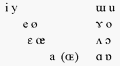
The area of phonology has been investigated by a number of young scholars working on their doctoral dissertations. In this context the following should be mentioned in particular: John Lonergan (University College Dublin), Arne Peters (University of Potsdam), Katrin Sell (University of Bamberg). More information on their work can be found in the section on Sociolinguistics.
John Harris (University College London) has continued his work on the phonology of Irish English with an examination of lenition, here and in a number of other languages, in an attempt to arrive at linguistically significant generalisations about this phenomenon. Work on lenition was also reported on by Mark Feinstein and his students (Hampshire College, Massachusetts) at the conference New Perspectives on Irish English (Dublin 2010).
| Syntax |
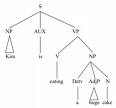
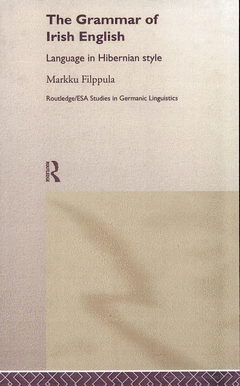
The syntax of Irish English has usually been dealt with in chapters in overview books. There are, however, a few monographs which deal explicitly with the grammar of Irish English. The two most noticeable of these are Alison Henry’s 1995 study Belfast English and Standard English. Dialect Variation and Parameter Setting (Oxford: University Press), Markku Filppula’s 1999 book The Grammar of Irish English. Language in Hibernian Style (London: Routledge) and Karen Corrigan’s 2010 book Irish English, Vol. 1: Northern Ireland. (Edinburgh: Edinburgh University Press).

-small.gif)
Recently there has been work on the grammar of Irish English, for instance by Marije van Hattum on modals in Irish English in their historical and present-day dimensions for her PhD at the University of Manchester. Other work on syntax was by Kalynda Beal (formerly University of Hamburg) on It-clefts in Irish English.
Tamami Shimada (Meikai University, Japan) has also being working on issues surrounding the syntax of Irish English.
| Vocabulary |

Research into the vocabulary of different varieties of Irish English has for many decades formed the backbone of scholarly activity in the field. In the past decade or so, a number of books have appeared dealing with this topic. Diarmuid Ó Muirithe is an author who has published widely on Irish English lexis as has Bernard Share whose book Slanguage went to a second edition (2003).
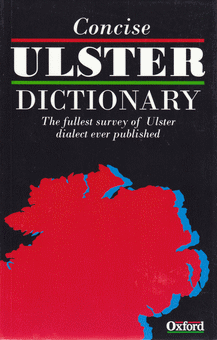
The specific vocabulary of English in Ulster has been treated in two significant volumes, the first the Concise Ulster Dictionary compiled and edited by Caroline Macafee (Oxford: University Press, 1996) and the second The Hamely Tongue. A Personal Record of Ulster-Scots in County Antrim by James Fenton (Newtownards: Ulster-Scots Academic Press, third edition 2006).
_small.gif)
The main dictionary with emphasis on English in the Republic of Ireland is the Dictionary of Hiberno-English by Terence Dolan (Dublin: Gill and Macmillan, third editon 2012), a fourth edition of which is currently under preparation. There is an associated website accessible at http://www.hiberno-english.com/.

.jpg)
.jpg)
See also the detailed chapter by John Kirk on the vocabulary of Irish English in Raymond Hickey (ed.) 2024. The Oxford Handbook of Irish English. Oxford: Oxford University Press.
| Pragmatics |

The pragmatics of Irish English has become the focus of research in recent years and culminated in the publication of two seminal volumes, the first by Anne Barron and Klaus P. Schneider (The Pragmatics of Irish English, Berlin/New York: Mouton de Gruyter, 2006) and the second by Carolina P. Amador-Moreno, Kevin McCafferty, Elaine Vaughan (Pragmatic Markers in Irish English, Amsterdam: John Benjamins, 2015).
_small.gif)
.png)
Scholars in Limerick have been paying particular attention to the subject, for instance, Elaine Vaughan and Brian Clancy (Mary Immaculate College, University of Limerick) who reported on their findings at recent conferences such as New Perspectives on Irish English series (Dublin, Limerick, Bergen) and more recently in a number of publications. Other colleagues working at the School of Languages, Literature, Culture and Communication (University of Limerick) have also been active in pragmatics research. For samples of this work, see the contributions to Volume 6.4 of Intercultural Pragmatics.
Comparative work in the field of pragmatics has also been done recently, e.g. by Martin Schweinberger (University of Hamburg) who examined the use of like in Irish English and other varieties of English and further work on the pragmatics of Irish English.
Further work on pragmatics has been done by Fiona Farr (University of Limerick), Bróna Murphy (University of Edinburgh) and Jozsef Andor (University of Pécs, Hungary). Anne Barron (Leuphana University, Lüneburg, Germany) has also been active in the field of Irish English pragmatics and supervises graduate work in this area, e.g with her PhD student Irina Pandarova.
Mention should also be made of the work on the responsive system of Irish English done by Gili Diamant from the Hebrew University, Israel.
In 2025 a further collection of articles on the pragmatics of Irish English appeared as Martin Schweinberger and Patricia Ronan (eds) 2024. Socio-pragmatic Variation in Ireland. Using pragmatic variation to construct social identities. Berlin: de Gruyter Mouton.
.jpg)
| Discourse analysis |
Discourse analysis contextualises language in a broader sociolinguistic framework. It is an approach used by many authors to investigate the socio-cultural and political background to the use of language by individuals and by groups in both spoken and written form. In this area of research, the Italian scholar Davide Mazzi has been especially active and has published a number of monographs availing of this approach, see Mazzi (2020, 2022, 2023).
.jpg)
.jpg)
| Teaching / Second Language Acquisition |
With the large number of foreign nationals now living in Ireland, Irish English is increasingly the target form of English in second language acquisition. This will obviously be a future area of research. It is, though, being currently broached in the following PhD thesis:
Markus Böttner (University of Bamberg) Hiberno-English: A Variety and its Function for Second Language Acquisition.
| Bilingualism / Code-switching |
In the history of Irish English there have been occasions when code-switching was common in written forms of the language. Macaronic texts from the seventeenth, eighteenth and nineteenth centuries clearly document this kind of language mixing. A recent treatment of this subject is to be found in the following book.
.jpg)
Mac Mathúna, Liam 2007. Béarla sa Ghaeilge – Cabhair Choigríche: An Códmheascadh Gaeilge/Béarla i Litríocht na Gaeilge 1600 - 1900. [English in Irish – Foreign help: Irish/English code-switching in Irish literature 1600-1900]. Dublin: An Clóchomhar.
Code-switching among bilingual individuals today is very common. Because of this the influence of English on today’s Irish is considerable. Much research has been done on this, above all by the American linguist Nancy Stenson.
| Language attitudes / Perception |

The attitudes of the Irish to their heritage language Irish have determined, and continue to determine, the way they view the English language which is now the native, i.e. first, language of over 99% of the Irish-born population of the Republic of Ireland. There is a complex history to language attitudes in Ireland and this reaches back to the initial period of settlement in the late twelfth century. English views of the Irish throughout the Tudor and Stewart periods did little to improve attitudes. The Victorian use of pseudo-Darwinism to portray the Irish is yet a further instance of colonial deprecation of the Irish. These attitudes were furthermore internalised by the Irish in many respects and their effects can still be noticed.
An overview of the historical attitudes of the English to the Irish can be found in the presentation The Aftermath of Shift. Statistics about the present-day Irish attitudes to both Irish and English can be found in the survey Language Use and Attitudes in Ireland carried out by Raymond Hickey between 2006 and 2009.
There is currently a large project being carried out jointly by Trinity College Dublin and Queen’s University, Belfast - Living Observatory of Shared Language and Identities (LIFELANGS), which is “dedicated to studying the languages and identities shared across different communities in Ireland”.