


Welsh English
Historical outline English has been spoken in the geographical area of Wales since the beginning of the Old English period. It first spread along the southern coastline of Wales and then up to the North. The mountainous central region remained monolingual longest. Despite the long history of English in Wales, bilingualism has been the rule since the very beginning. There were no plantations on the pattern used in Ireland nor was there a religious conflict of the type which added increased vigour to the efforts at stamping out Irish in Ireland.
In 1535 and 1543 two Acts of Union were passed through the English parliament formally binding Wales to England and making English the official language in the region. The industrialisation of Wales and the expansion of the infra-structure of the country led to a natural decline in the numbers of Welsh speakers. Early census figures can only be taken as approximations but nonetheless give an idea of the decline in the language, at least as far as monolinguals are concerned. The census of 1931 returned a figure of 35% bilinguals and 4% monolinguals, that of 1971 showed 19.6% bilinguals and less than 1% monolinguals. What these figures do not reflect is the active part in Welsh social and cultural life which the language plays. There is Welsh radio and television, which broadcast over one third of the time entirely in Welsh. The cause of the Welsh language has also long been represented by the Welsh Language Society with varying and often controversial effects.
Literature and newspapers appear in Welsh and the language is taught in all primary and most secondary schools. Needless to say the only hope for Welsh (and indeed for Irish and Scottish Gaelic) up against the world language English is that a diglossic situation develops in which Welsh takes the position of the L-variety (that used in the private and domestic spheres) with English retaining its dominant position in public life (as H-variety).
Language maintenance is largely a matter of motivation in the population which still speaks the language and less a matter of political decrees. In the case of Welsh the motivation is fairly high as speakers see in the language a means of identifying themselves with their region and setting off Wales from the rest of mainland Britain. This would appear to be particularly true of the rural north as opposed to the more urban south.
The word Welsh derives from the Old English word wealh ‘foreigner’, ‘slave’ - but also ‘Celt’ - and occurs as a surname also with an additional form Wallace going back to Anglo-Norman walleis. The root behind Welsh is found on the continent as well. It is the source for German Welsch, the Swiss canton Wallis, the Belgian group of the Walloons; in all these cases, the reference is not to Celts but to Romance speakers. The root is furthermore found in German Wallach ‘gelding’ and in the Wallachei.
Features of Welsh English The English spoken in Wales does not differ from more standard forms of English, especially when it is compared to either Scottish or Irish English. There is little in the syntax which is specifically Welsh so that the main features are phonological with one or two morphological characteristics and a few lexical items such as bach and gel as terms of endearment.
Phonology The most general feature of Welsh English is the lilting intonation due to the rise-fall at the end of statements as opposed to the fall in other forms of English. Long vowels tend to occur only in stressed syllables. There is little distinction in length among low vowels so that words like grand and grass sound as if they had the same vowel. A central schwa is found for the /ʌ/-vowel in words like cut, but /kət/, /bət/. Long final vowels occur such as /i:/ in sorry /sɒri:/. Yod before /u:/ is often deleted as in regulate /reguleit/.
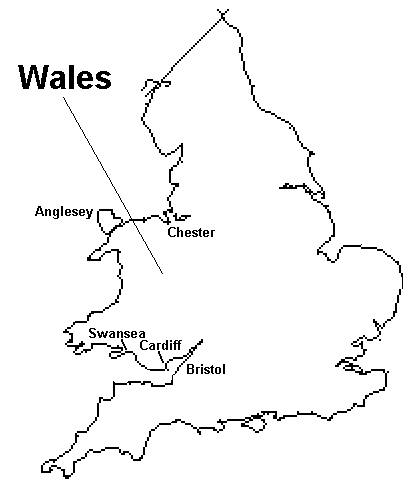
Welsh - the Celtic language - is found in two major varieties, a northern and a southern one. The north of Wales tends to be more rural and the south, certainly in the regions of Swansea and Cardiff, is mainly urban. In keeping with the division for Welsh there are some distinctions between the English spoken in the north and that in the south of the country. Southern Welsh English is h-less where Northern Welsh English tends to be h-ful, i.e. /h/ occurs in initial position. In the south a clear /l/ is commonly used for all types of English /l/ - i.e. in syllable-initial and in syllable-final positions which have a clear and a dark /l/ in Received Pronunciation respectively - whereas in the north the velar /ɫ/ may well predominate.
Morphology Multiple negation is found as in We don’t speak no English in the home. As is frequently used as a relative pronoun, The woman as went abroad. Them acts as a demonstrative adjective Them men who sing so well. Unstressed do can be employed to express a durative aspect as in Irish English (see above) The children do be playing in the yard after school. Fronting as a means of topicalisation is quite acceptable, Books on linguistics he is keen on reading.
