


South-East and East Asia
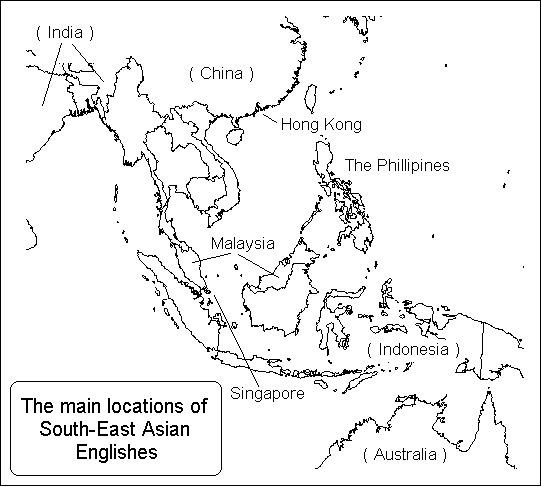
From the anglophone point of view South-East Asia consists of Singapore, Malaysia, The Philippines and Hong Kong (see separate modules on the first and the last two of these). The types of English spoken here again depend on such factors as the degree of education and the substrate influence of background languages. In Malaysia the native language Malay plays an important role, as do Indian languages and Chinese in Singapore as well as Chinese, in particular its southern forms, in Hong Kong.
.png)

English in Malaysia
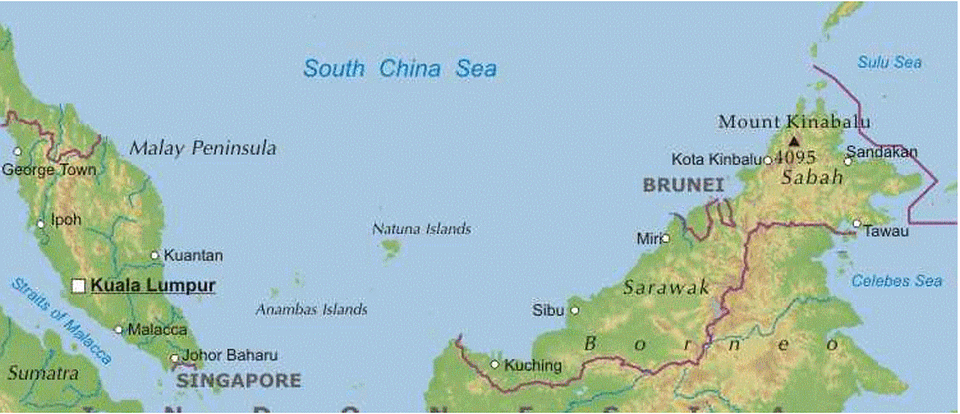
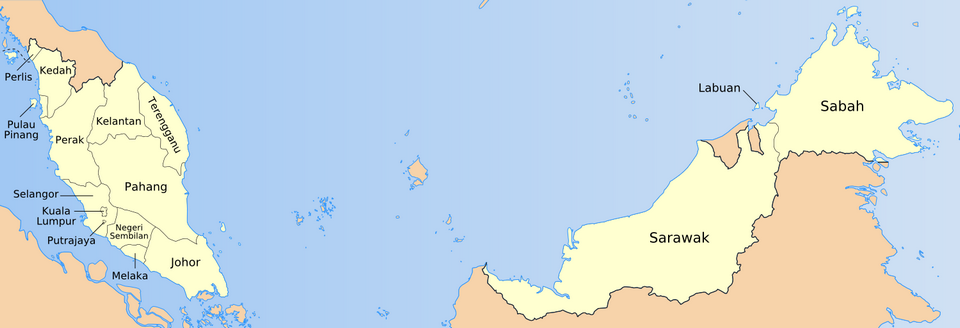
The Federation of Malaysia consists of (i) West Malaysia, or Peninsular Malaysia, on the Asian mainland, forming the southern part of the Malay peninsula, south of Thailand, but excluding Singapore at the tip and (ii) East Malaysia, or Malaysian Borneo, on the northern coast of the large island of Borneo (Kalimantan in the central and southern Indonesian part). The latter is divided into the state of Sarawak to the west and the state of Sabah to the east with the independent state of Brunei in between the two.
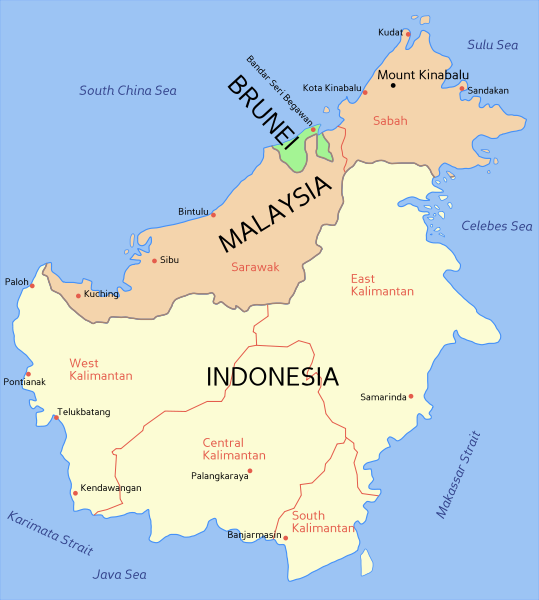
English in Malaysia forms a continuum from a basilect, often termed Manglish and heavily influenced by Malay (spoken by about 60% of the population), to an acrolectal form which has historically had an exonormative orientation towards British English. However, since independence in 1957 the predominance of English in public life and in education has waned. English is more favoured by the 26% Chinese section of the population and the 7% Indians in Malaysia.
Malaysian English tends to be non-rhotic and the interdental fricatives are generally realised as stops. A large range of pragmatics markers is to be found in spoken Malaysian English which derive from forms of Chinese.
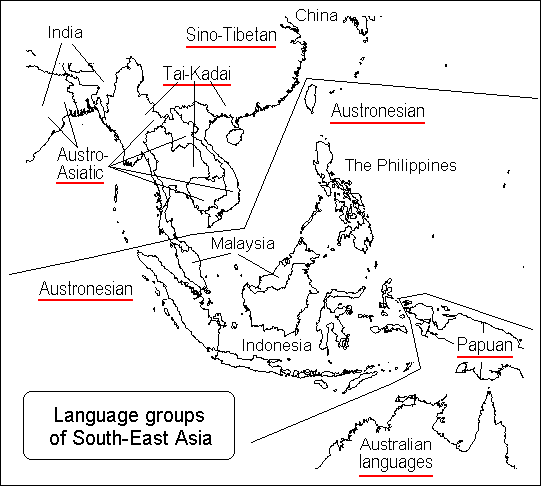
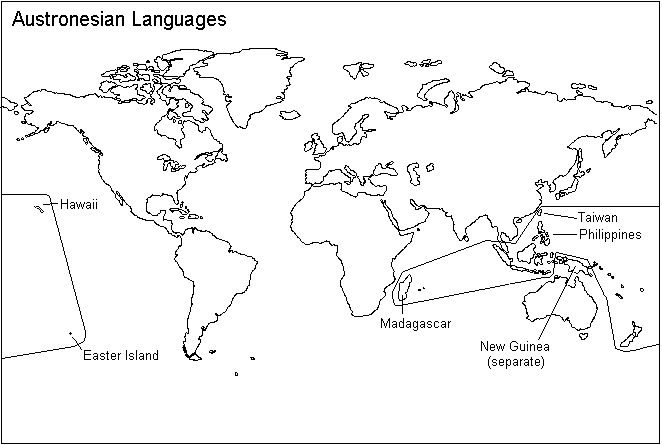
+The Malay language is spoken in the state of Malaysia and, in a slightly different form, in Indonesia by well over 200 m native speakers. It is found throughout the following countries: Indonesia, Malaysia, Singapore, Brunei, parts of Thailand. Malay is an Austronesian language belonging to the Western Austronesian branch.
Malay is agglutinative in type and has a basic SVO word order. Slightly different versions of the Roman alphabet are used for Bahasa Malaysia and Bahasa Indonesia. The influence of Dutch on Bahasa Indonesia is minimal but that of English on both forms is considerable.
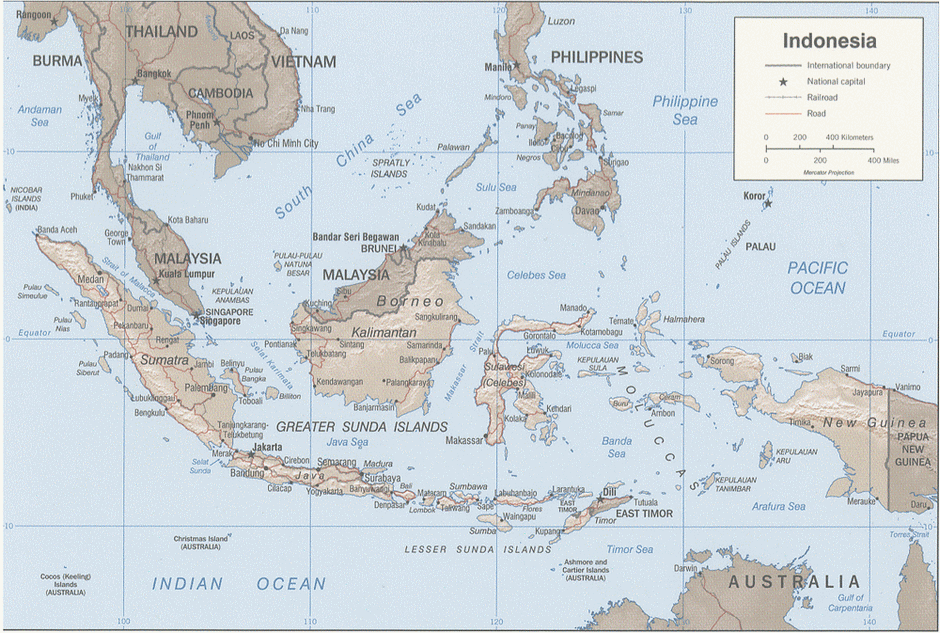
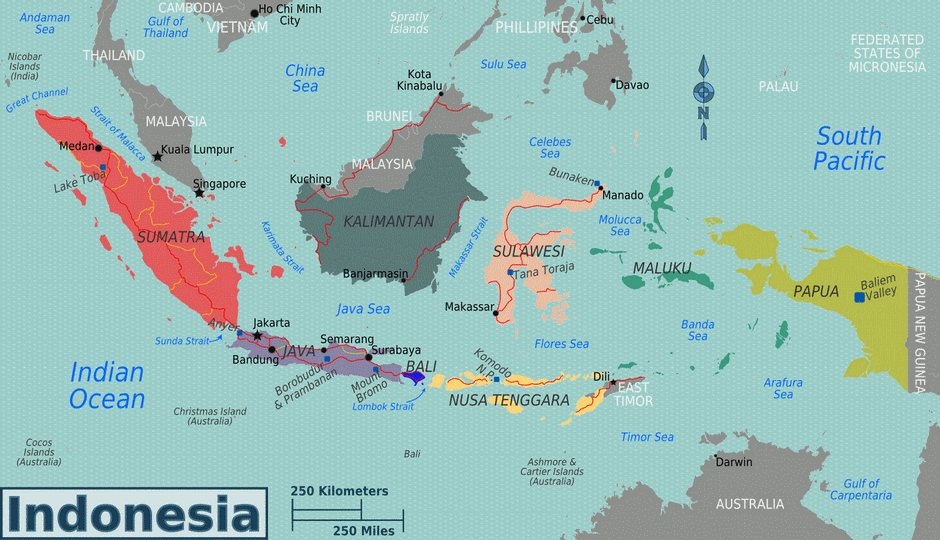
Indonesia is the largest country in South-East Asia with a land area of nearly two million square kilometres and a population of over 280 m. Its colonial history is Dutch, being administered for a few centuries by the Dutch East India Company. It declared its independence from The Netherlands in 1945 and became the Republic of Indonesia. The official (standardised) language is Indonesia (Bahasa Indonesia), a form of Malay (an Austronesian language), which is largely mutually comprehensible with Bahasa Malay spoken in Malaysia.

Deterding, David and Nur Raihan Mohamad 2026. English in Brunei and Malaysia. In Raymond Hickey (ed.) The New Cambridge History of the English Language, Vol. 6: Africa, Asia, Australasia and the Pacific. Cambridge: Cambridge University Press, pp. 253-270.