


English in Singapore
Linguistic features of New Englishes
Literature on English in Signapore
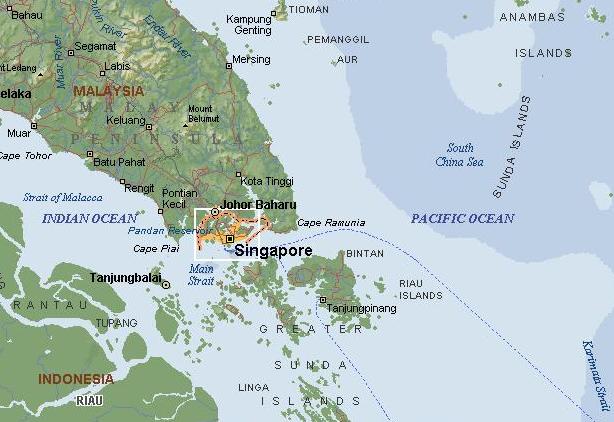
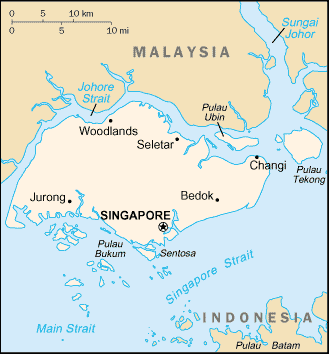
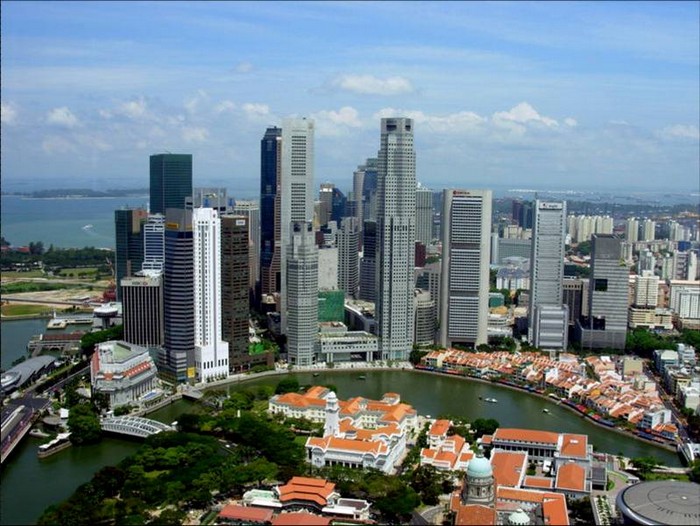
Singapore was founded in 1819 by Sir Stamford Raffles by signing a treaty with a local Sultan on behalf of the British East India Company. In 1826 it became the Straits Settlements and grew rapidly in population due to immigration by Chinese, Malays and later Indians to work in the rubber industry, in mining and railway building. In 1963 Singapore joined the Federation of Malaysia along with the mainland Malay provinces and the state of Sarawak and Sabah on Borneo. It left the Federation in 1965 becoming the independent Republic of Singapore.
Ethnic composition of Singapore
There are three main ethnic groups comprising a total of some 4.4 million speakers (2002): (1) Malay 14%, (2) Chinese 77%, (3) Indian 7%. The Republic of Singapore has four official languages - English, Chinese, Malay and Tamil of which the national language is, for historical reasons, Malay.
The English language is continuously increasing in importance in Signapore. The authorities have been concerned with establishing it as the first language of public life. The other main languages are Chinese, Malay and Tamil. To this end they have instituted school programs which expose young Singaporeans to English from elementary school onwards. A linguistically interesting question is whether new generations of native speakers of English can result from this kind of language planning.
Singlish A strongly vernacular form of English spoken by local inhabitants in Singapore. It contrasts strongly with Singapore English, which is supported by the government and is the form of English used in international trade and cultural exchanges. Singlish arose through intense contact with various languages present in the region in the early period of English settlement and has been classified as a creole by some scholars.
Linguistic features of ‘New Englishes’

The term ‘New Englishes’ has been used to refer to forms of English which have arisen as second-language varieties in parts of the world, chiefly in Africa and Asia, where British colonial influence was strong but where there was no significant amount of settler English. English in such regions contrasts to that in Australia or Canada, for example.
English is frequently acquired in an unguided fashion in regions with ‘New Englishes’. Because of the frequently restricted nature of the input, certain features, such as the following, may be at a premium.
1) Foregrounding of pragmatic information to compensate for insufficient competence in the target language. Certain devices are employed to this end, e.g. topicalisation through fronting to highlight new information in an exchange (Its wedding of my brother soon). Left dislocation of the given information can also be found (My brother, there is wedding soon).
2) Backgrounding of morphology and complex syntax. Preference for word order over inflection, parataxis over hypotaxis. Preference of intonation over syntax in interrogative sentences (You like new car?).
3) An adherence to natural order in syntax (He drink much wine when he come home rather than After he come home he drink much wine).
Redundancy in English
Use of ‘be’ in equative sentences.
I (am) a lecturer in linguistics.
Double marking of various kinds, e.g. nouns immediately preceded by numerals
This book costs twenty pound(s).
Relative clauses with a relative pronoun and an unambiguous word order
There is a man outside Ø waiting for you.
Typologically unusual features in English
1) Lack of inversion in embedded interrogative clauses
I’m wondering whether he has gone. (with inversion: I’m wondering has he gone.
2) Inflection on only third person singular present tense
N.B.: In the colonial situation people may have been exposed to varieties in which a reanalysis and reallocation of verbal -s had already taken place.
3) The existence of a present-perfect tense
4) Negative attraction (Nobody has come for Anybody hasn’t come)
5) The use of tags with number agreement and inverse polarity (Linguistics is interesting, isn’t it?)
Dealing with afunctional syntactic and morphological irregularity
There are three basic options:
1) It is carried forward as irregularity, the less prescriptive the acquisitional environment the less likely this is.
2) It is neglected in the emergent target variety. This is likely to take place in a non-prescriptive environment, assuming that the formal markers of this irregularity are not subject to innovative interpretation (or later to re-functionalisation).
3) a. formal regularisation with innovative interpretation
This innovation is normally motivated by the search for equivalents to categories in a background language and not evident in the target variety as it presents itself to those engaged in acquiring it.
3) b. subsequent functionalisation
This may have a similar motivation to innovative interpretation but crucially it takes place after the establishment of the target variety. Thus this refunctionalisation is not motivated by universals of unguided second language acquisition.
Metaphorical extension
This occurs after the acquisition / establishment of a new variety
Colloquial Singapore English:
Extension: Use of get as a possessive or existential marker
Trajectory: action of receiving/acquiring something > generalised possession > generalised existence
You got nice shirt. ‘You have a nice shirt.’
Here got very many people. ‘There are very many people here.’
Neglect of categories and distinctions in English
The neglect of categorial distinctions in English is common in second/foreign language varieties and older language shift varieties when these distinctions are/were not present in the background languages. For instance, Malay does not distinguish pronominally between he and she. It has a determiner itu. Tamil has a system of vowel prefixes (i, e, a, u) which are the rough equivalents of demonstratives in English. Sino-Tibetan languages (including Putonghua/Mandarin and Hokkien) do not have definite and indefinite articles.
The upshot of this is that pronominal distinctions and the use of articles do not correspond to usage in standard varieties of English.
There may be a mixture of motivations here: the influence of the background languages combined with more general aspects of unguided language acquistion which might favour a neglect of formal distinctions which are obvious from a discourse context.
Investigations in situ, if possible, can supply clues about how features become established in emerging varieties and can offer documentation of early steps on trajectories, which are perhaps attested at later stages in more established varieties. Such investigations can also help in the relative weighting of the chief factors, namely L1 transfer, input varieties of the target language and general principles of second acquisition in non-prescriptive environments.
.png)
Literature on English in Signapore
.jpg)
.png)
.jpg)

Leimgruber, Jakob R. E. 2026. English in Singapore. In Raymond Hickey (ed.) The New Cambridge History of the English Language, Vol. 6: Africa, Asia, Australasia and the Pacific. Cambridge: Cambridge University Press, pp. 229-252.
