English in Scotland
Phonology
Grammar
Lexis
Maps
References
.jpg)
Historical outline
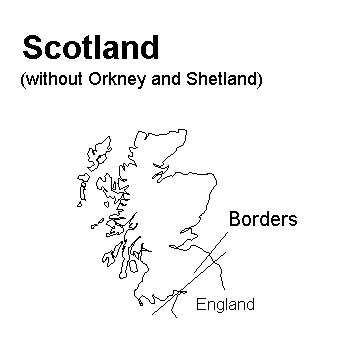
Of the three Celtic areas left in present-day Britain, Scotland is definitely the one with the oldest tradition of English, both spoken and written. While in Ireland a literature in Irish arose in the Old English period which was to have an influence even on continental Europe, writing in English only developed slowly at the end of the Middle English period. In Scotland, however, English became firmly established in the early part of the Middle English period spreading northwards from the dialect area known as Northumbrian in the Old English period (i.e. the geographical area north of the river Humber and south of the Cheviot hills which forms the natural boundary between England and Scotland.
The term Scotland comes from Latin Scotii (originally a term for the Irish), who settled the western coast of Scotland and Christianised it before England was converted from the south with the mission of Saint Augustine at the end of the 6th century. The adjective Scottish has two further variants Scots and Scotch which may be used with different meanings, for instance Scots is used to refer to the particular variety of English spoken natively in Scotland and Scotch is nowadays almost solely confined to the country’s type of whiskey.
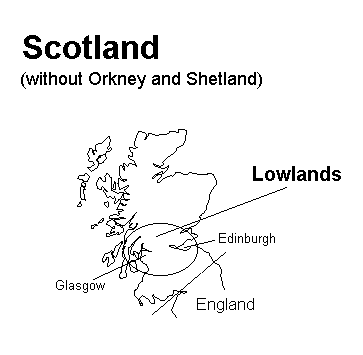
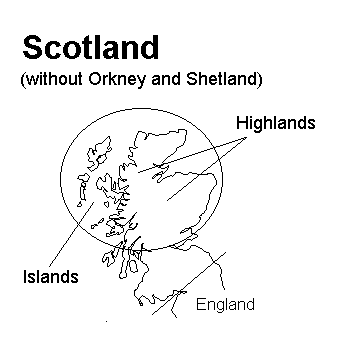
The advance of English in Scotland was at the cost of Scottish Gaelic (Gallick)which was pushed back out of the Lowlands into the Highlands north of the Firth of Forth.
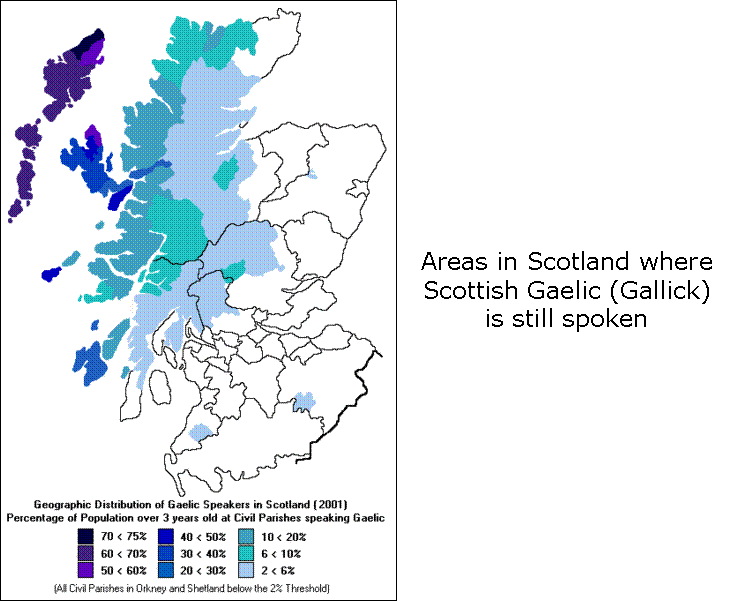
The variety of English which established itself at this early stage later on developed into what is called Lallands (< ‘lowlands’) and has kept its identity as a distinct variety – Scots – even to the present-day. The speakers of English in this initial period were often English settlers who had been invited by the Scottish king to settle and render arable the plains of the Lowlands.
Note: For the purpose of the present presentation, I am not considering Scots a language separate from English, though I am fully aware of the different opinions on this matter and the intense debates which it has given rise to.
.png)
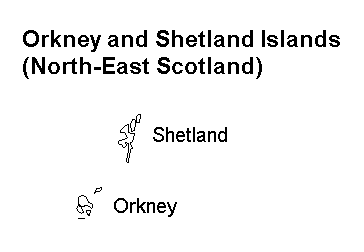
Through mixed marriages and gradual assimilation of the Gaelic-speaking community in the lowland area, Scottish Gaelic became weaker and weaker. By the Early Modern English period (in the Elizabethan era) Scottish Gaelic was only spoken by monolinguals in the Highlands and Islands (i.e. on the large islands on the west coast of Scotland). A further language, Norn, which was a remnant of Old Norse spoken on the Orkney and Shetland islands, disappeared finally in the 18th century.
At least four distinct varieties of English exist in Scotland: 1) Lallands, the most original of all varieties of Scottish English, 2) Contact English which is that spoken by speakers of both Scottish Gaelic and English and 3) Standard Scottish English which is a locally flavoured version of southern supraregional English, 4) more recently developed urban varieties, spoken chiefly in Edinburgh and Glasgow. In addition, there are affected accents close to Received Pronunciation which are known by the middle-class suburbs of the two main cities in Scotland where they occur: Morningside and Kelvinside (in Edinburgh and Glasgow respectively).
In the area of phonology the indigenous Scottish varieties show strong deviations from southern supraregional English. Syntactic peculiarities are to be found above all in the contact varieties of English where the syntax of Scottish Gaelic has lead to a variety of constructions which have no parallels in southern supraregional English. Here the position is like that of Irish English: a certain number of syntactic characteristics have been retained from contact speech, even with those speakers who no longer have a command of Scottish Gaelic. Examples of such contact phenomena are 1) the use of a durative tense as I do be in the office of a Tuesday, 2) the formation of a kind of perfective which may contrast with a simple past tense as Have you read ‘Ulysses’? versus Have you ‘Ulysses’ read? or He is after eating his dinner versus He has eaten his dinner and 3) the use of a dative of relevance as in The fire went out on me or The soup boiled over on her.

Phonology
The most archaic varieties of Scottish English (i.e. the lowland varieties) have not gone through the Great Vowel Shift. The diphthong which one nowadays has in words like down is still represented by a monophthong /u(:)/ (with varying length) while the but sound is still an unshifted /u/. In addition, a number of specifically Scottish characteristics are to be found. Most noticeable of these in the area of phonology are 1) a strongly retroflex if not rolled /r/, 2) the lack of vowel length contrasts so that words like full and fool are homophones, 3) the retention of the wh sound in words like which, whale, 4) the presence of /ei/ for English /o:/ as in the Scottish pronunciation of words like home, 5) a distinction between front and back short vowels before /r/ as in germ /džɛrm/ and burn /bʌrn/ and 6) the inherited sound /x/ still found in traditional varieties. Initial /h/ as well as [ʍ] for /hw/, wh- are common almost everywhere. In some words the lack of palatalisation of /k/ is still to be seen, this having been carried out in practically all other varieties of English: kirk for church, rigg for ridge.
A central aspect of Scottish English is the so-called Scottish Vowel Length Rule or Aitken’s Law, after the Scottish linguist who first described it linguistically. It specifies that vowels are lengthened (normally they are short in Scottish English) before voiced fricatives, /l/ and /r/. Here one has a case of phonetic conditioning for lengthening as a following voiced sound often causes a vowel preceding it to be realised as long, cf. the vowel in standard English bad [bæ:d] vs. bat [bæt].
Grammar
Different types of Scottish English show different degrees of grammatical difference from southern British English. For instance, the modal will tends to stand for both shall and may, the passive is often formed with get: I got told off (now common elsewhere); it is often used for compulsion: You’ve got to speak to her; must is used in an epistemic sense in both the positive and the negative: She musn’t be Scottish for She can’t be Scottish; the pronoun with -self is used non-reflexively: Himself isn’t at home yet for The man of the house is not at home yet; the abbreviated form of am + not is amn’t as in Amn’t I right?; generic pronominal references tend to use -one rather than -body: Someone has to do the work (all features found in Irish English as well). Future negation is formed with independent not rather than the clitic form of a modal and not: She’ll not go home for She won’t go home.
Lexis
The vocabulary of Scottish English is rich in borrowings from both Gaelic (cf. loch ‘lake’, burach ‘mess’, cailleach ‘old woman’) and Old Norse (cf. bern for ‘child’). Three major lexicographical works are 1) A Dictionary of the Older Scottish Tongue from the 12th to the end of the 17th century, 2) The Scottish National Dictionary (from 1700 to the present-day) and 3) The Concise Scots Dictionary.
Two others sources for Scottish English are (1) The Linguistic Survey of Scotland (with its centre at the University of Edinburgh) and (2) The Survey of English Dialects (centred at Leeds) which deals with Scottish English alongside the other varieties of British English. Both these projects have produced much linguistic literature (atlases and interpretative monographs) with information on the English spoken north of the border.