


English in the Philippines
English in the Philippines was established after the Americans defeated the Spanish in 1898 and acquired this country (and Cuba) as overseas territories. Until after the Second World War there was a considerable influence of American English on public language usage in the Philippines, a noticeable exception in the context of other South-East Asian countries.
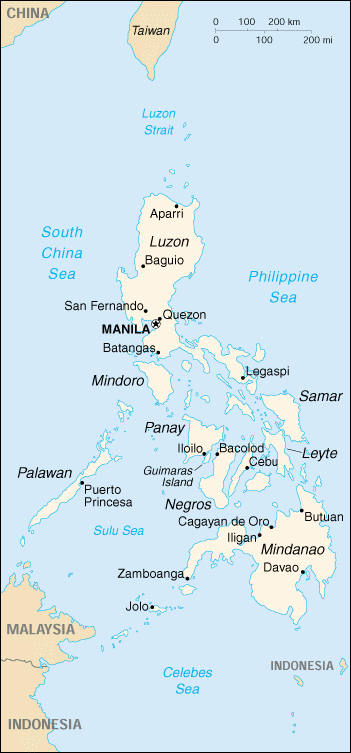
With an area of some 300,000 square km and a population ofabout 115 m The Philippines is a major country of the region, comparable to Malaysia but considerably smaller than Indonesia. Ethnically, the inhabitants of the Philippines are Malays who were Christianised by the Spanish and today over 80% of the population is Roman Catholic. The two official languages of The Philippines are Filipino (an official form of the Austronesian language Tagalog) and English, although only a small percentage speak it natively.
The Philippines are named after King Philip II (1527-1598) of Spain. The country was discovered by the Portuguese navigator Ferdinand Magellan in 1521 (while in Spanish service). Later tension arose between Portugal and Spain and in 1542 Spain re-claimed the islands for themselves, naming them after its then king.
Indigenous languages
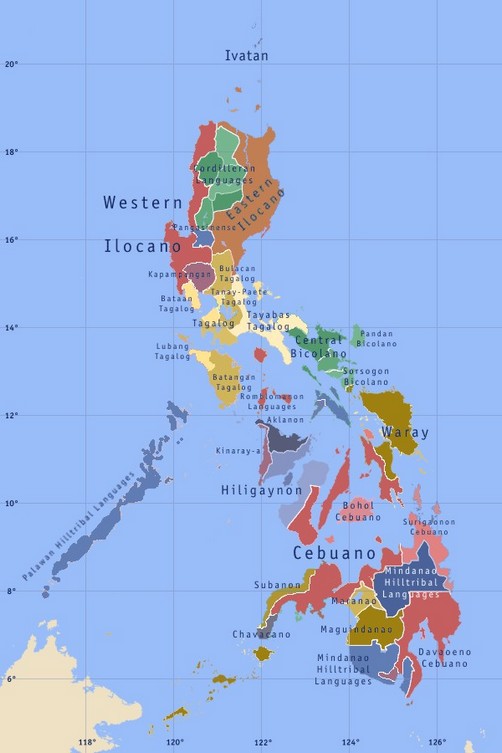
Tagalog (stressed on the second syllable) is an Austronesian language (like Malay) and has over 30 m speakers mainly on the northern island of Luzon and is the chief indigenous language in the area of metropolitan Manila. Tagalog is agglutinative in type and has a basic VSO word-order for sentences without particular focus. The official language Filipino is a form of Tagalog.
Cebuano is an Austronesian language spoken in southern parts of the Philippines by over 20 m people. The cultural history of sea trade led to the spread of varieties throughout the Philippine archipelagos. There are other languages such as Ilocano and Bicol which have several million speakers each.

Martín, Isabel Pefianco and Julius C. Martinez 2026. Englishes within and beyond the Philippines. In Raymond Hickey (ed.) The New Cambridge History of the English Language, Vol. 6: Africa, Asia, Australasia and the Pacific. Cambridge: Cambridge University Press, pp. 271-294.
