English in England
The Celtic regions
Dialect areas in England
Maps of dialect areas in England
Urban varieties of English
References
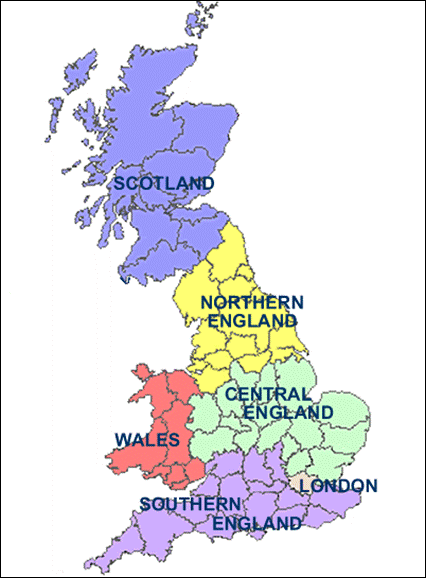
Isoglosses in England
An isogloss is a line drawn on a map which separates areas which differ in some linguistic feature, of pronunciation, grammar or vocabulary. Isoglosses indicate approximate boundaries which may or may not correspond to sociolinguistic differences between groups such as rural and urban inhabitants, younger or older speakers or individuals who are native to an area and those who are emigrants, either from abroad or another region within the same country.
There are a number of common isoglosses for English dialects. An obvious one is the presence or absence of /r/ when it is not immediately before a vowel, e.g. in words like car and card. Within England the absence is typical of large regions of the south, but parts of the south and south-west still retain non-prevocalic /r/. Another prominent isogloss is that separating the northern area with unshifted short /ʊ/ and that in the south where this sound has been unrounded and lowered to /ʌ/. An additional isogloss - and one which has sociolinguistic significance - is that separating areas with initial /h-/ and those without it. The loss of /h/ in initial position is endemic in urban forms of British English with the exceptions of Scotland and the far north of England, the region of Newcastle and Durham.
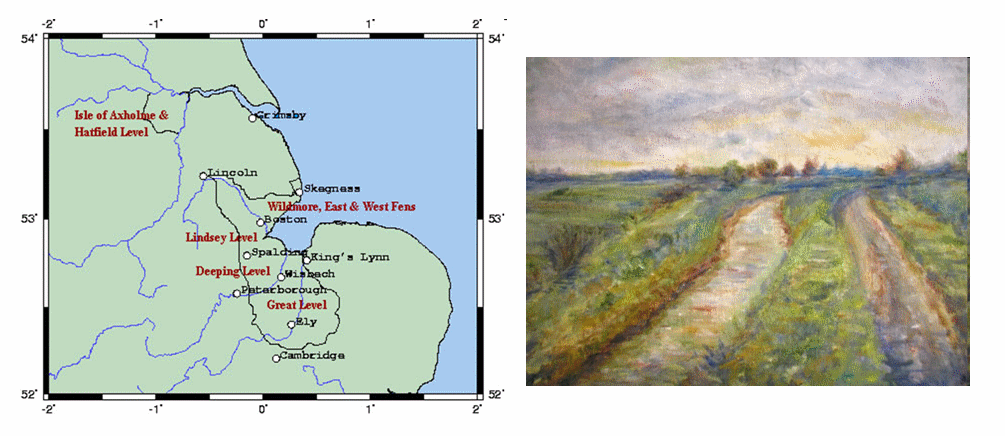
There are regions where two major areas adjoin and where dialect contact has led to mixed forms of language arising over a relatively long period of time. One such region is the Fen Country, the area around The Wash, a bay-like area in the centre of England’s North Sea coast. Here varieties of English in the lower south of the Northern Region have been in contact with varieties of the East Midlands and East Anglia through speaker accommodation with new composite varieties arising.
Speaker awareness of variation
Variation in English shows varying degrees of salience for lay speakers. Some features are unconscious but others form part of the general knowledge of English which speakers have. For instance, consider that alveolar stops are liable to be phonetically reduced. There are many ways for this to occur, including full deletion - frequently the end of a series of weakenings, here is a selection of options: /t, d/ > [ʔ], [ṱ], [ſ], [h], ø.
Another example which shows this kind of speaker awareness is the shift of /ŋ/ to /n/ in participle forms of verbs which goes under the phonetically inaccurate description of ‘dropping one’s g’s’. This is a feature which is found in a number of widely separate varieties and may well be stigmatised although widespread.

The Celtic regions
Before the arrival of the Romans (in the last decades BC), and before the coming of the Germanic tribes as of the 5th century CE, the British Isles were almost entirely Celtic. The story of these peoples since has been one of ground lost to the expanding English speakers so that the present distribution on the fringe of the British Isles is the result of a long and continuous process of peripheralisation.
Celtic is divided into two main branches on the basis of early treatment of keywords, cf. Welsh pemp and Irish cúig ‘five’ where the former has a /p/ and the latter a velar reflex of /kw/ at the beginning of the word. From the present-day point of view the most vital of the Celtic languages is definitely Welsh with something like half a million speakers, though here as with the other Celtic languages, one must be careful about definitions: some speakers can only say a few words of their putative native language while others can converse equally well in this and in English.
Note. The following figures represent those people who speak the Celtic language in question as an everyday community language (outside of the education system) at present (2020s).
| P-Celtic | Approx. no. of native speakers |
| 1) Irish | over 30,000 |
| 2) Scottish Gaelic | over 50,000 |
| 3) Manx (died out in 20c) | — |
| Q-Celtic | Approx. no. of native speakers |
| 1) Welsh | over 500,000 |
| 2) Breton | around 100,000 |
| 3) Cornish (died out in 18c) | — |
In all the Celtic regions English has been much affected by the structure of the particular Celtic language spoken there. Pronunciation and sentence patterns are the two areas which show greatest diversity compared to more standard forms of southern British English. However, not all characteristics are traceable to a substrate source. One must bear in mind that in these areas regional forms of English were imported which were different from supraregional southern English to begin with, probably more archaic in structure. Furthermore features may have developed quite independently of these two main sources.
Dialect areas in England
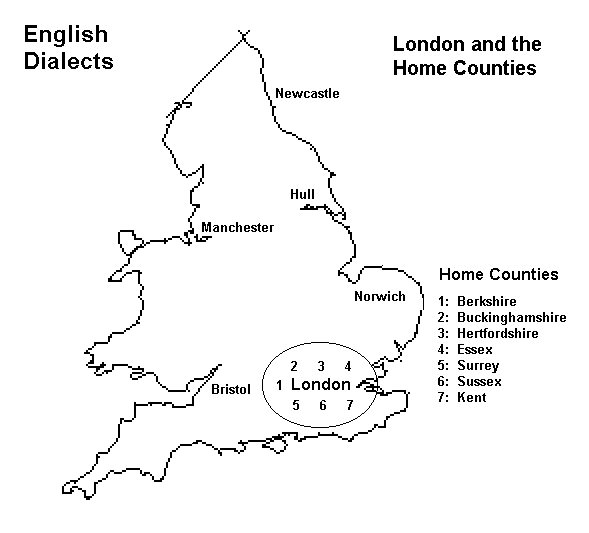
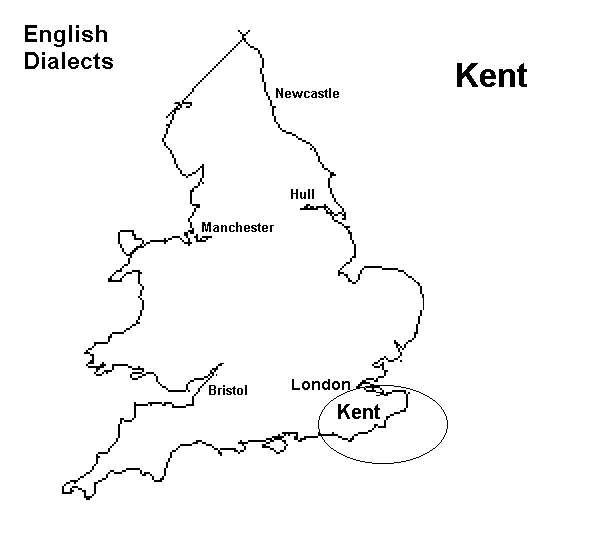
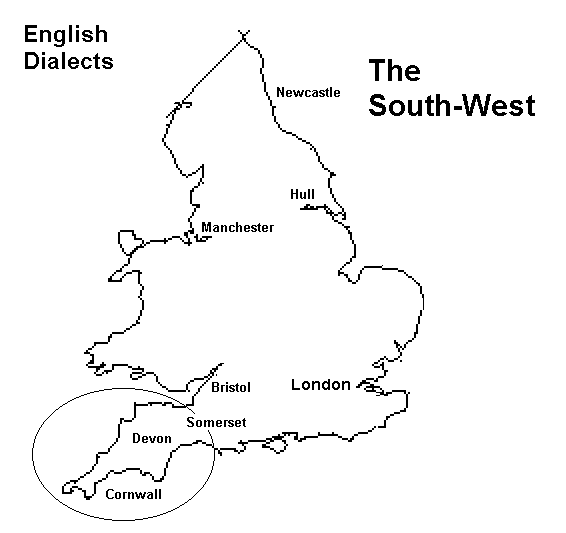
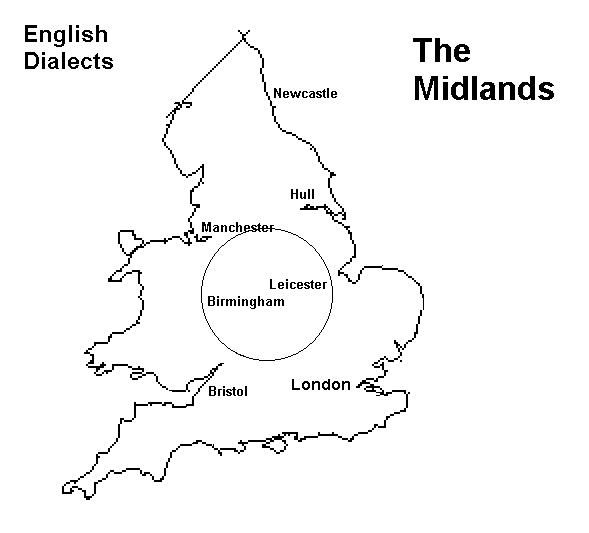
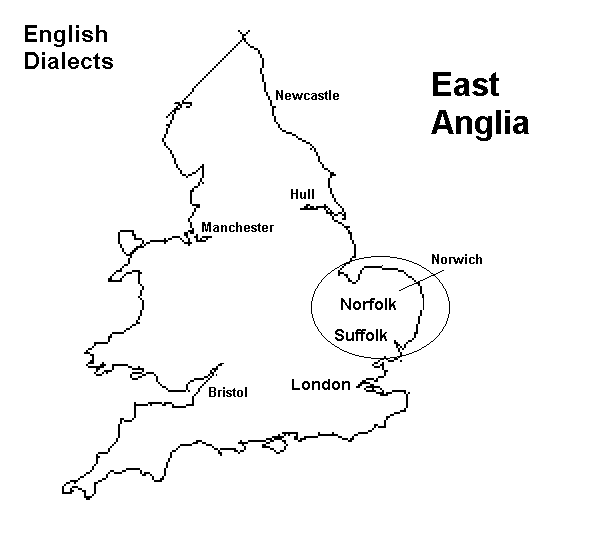
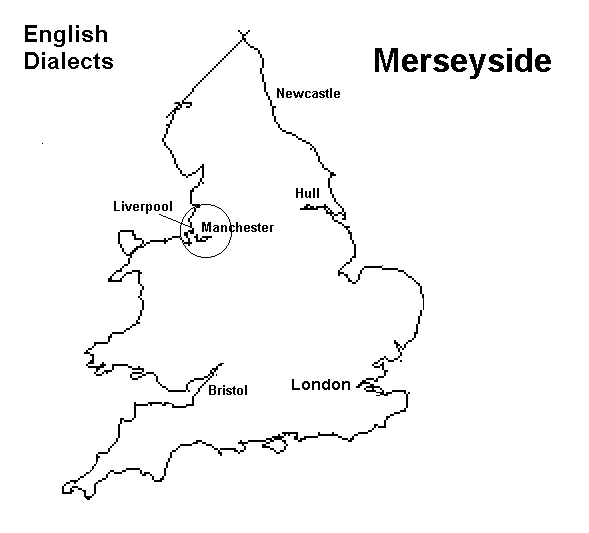
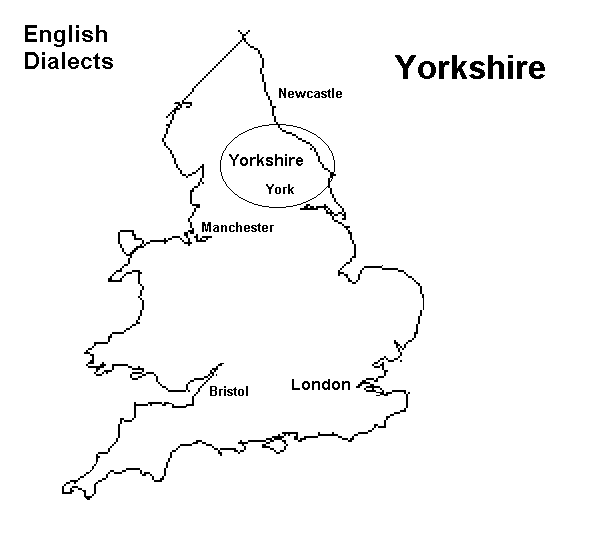
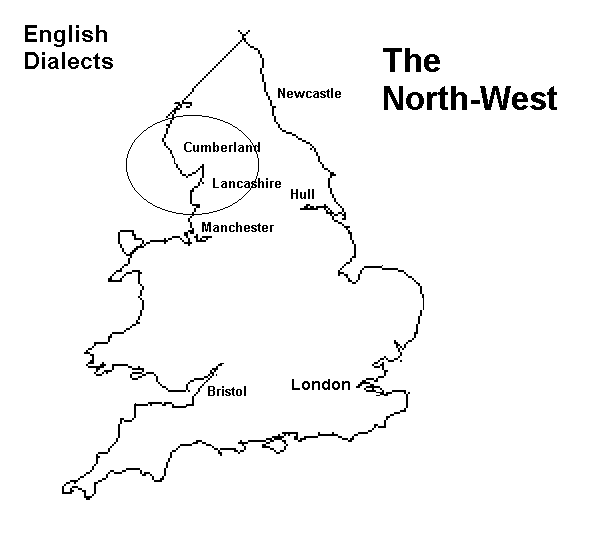
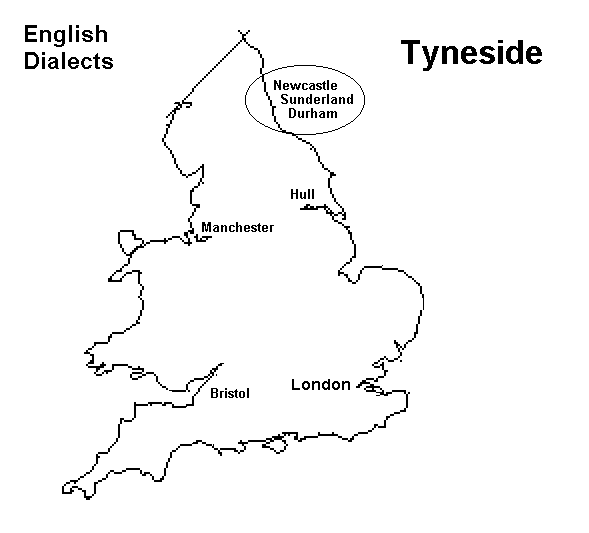
The maps above show large geographical regions of England. However, the majority of the English population lives in cities and here there is much greater variation than in the countryside, this variation being determined by sociolinguistic factors such as ethnicity, age, gender. Several of these cities have been the object of sociolinguistic investigations in recent decades, e.g. London, Reading, Milton Keynes, Norwich, Liverpool, Sheffield, Newcastle, Middlesbrough. Many colloquial features of London English have spread to other cities, and are continuing to do so, e.g. TH-fronting (pronouncing a word such as think like fink), T-glottalling (using a glottal stop for a /t/ in a word like but or butter) or L-vocalisation (pronouncing the /l/ in a word like milk as /u/).
.jpg)
.gif)