


Chicano English
Demographics
Self-perception
Linguistic features
Literature on Chicano English
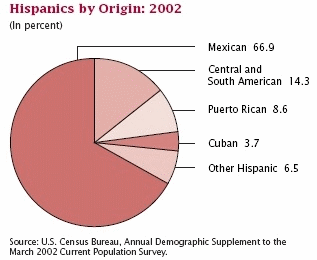
The word ‘Chicano’ refers to the people, culture and forms of English of those individuals in the USA who are of Latin American origin. The generic terms ‘Hispanic’ and ‘Latino’ are also common and there is debate in USA society as to which term to use. Official census figures used the term Hispanic in the 1970s but later changed to the combined label ‘Hispanic or Latino’. The label ‘Hispanic’ is slightly older in use, with ‘Latino’ increasingly in general popularity in recent years. There is no accepted distinction between ‘Hispanic’ and ‘Latino’ in terms of which ethnic subgroup they might refer to. Many people prefer a more specific usage when referring to their ethnic background, e.g. Puerto Rican, Cuban, Mexican, Costa Rican, Guatamalan, etc.

Demographics
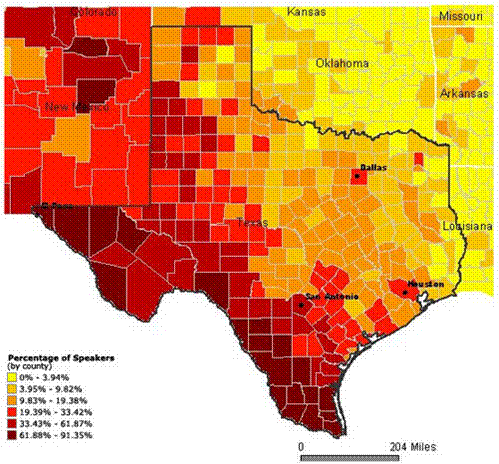
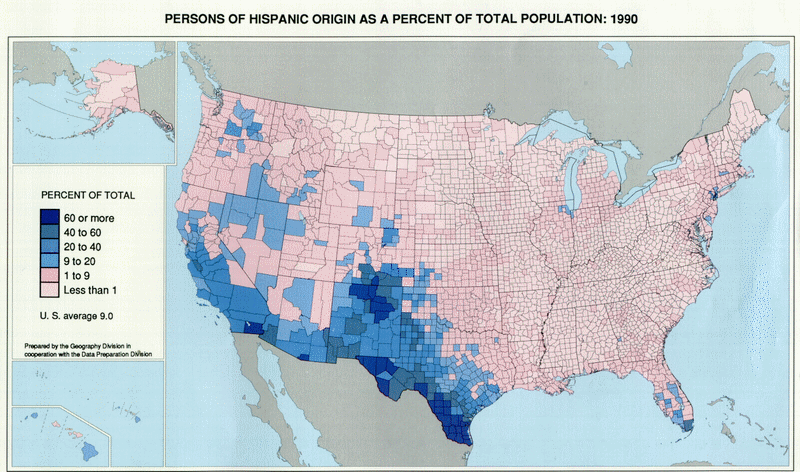
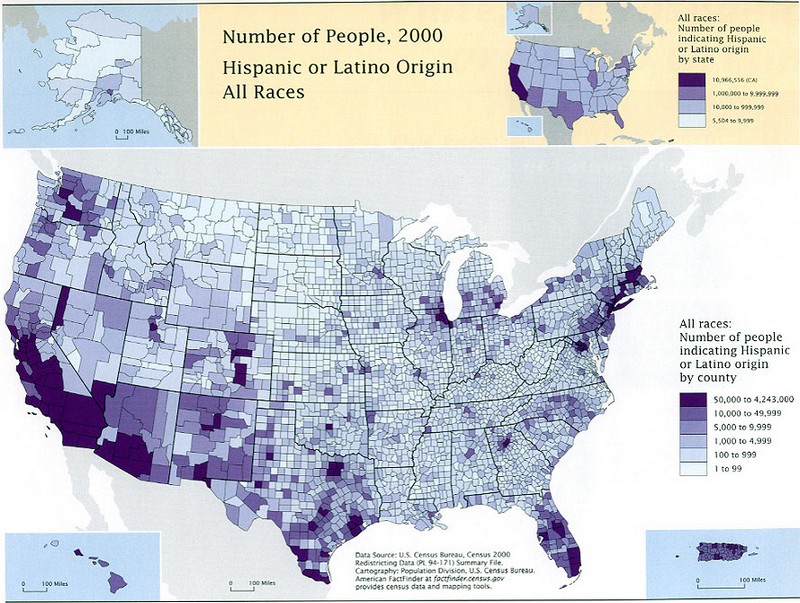
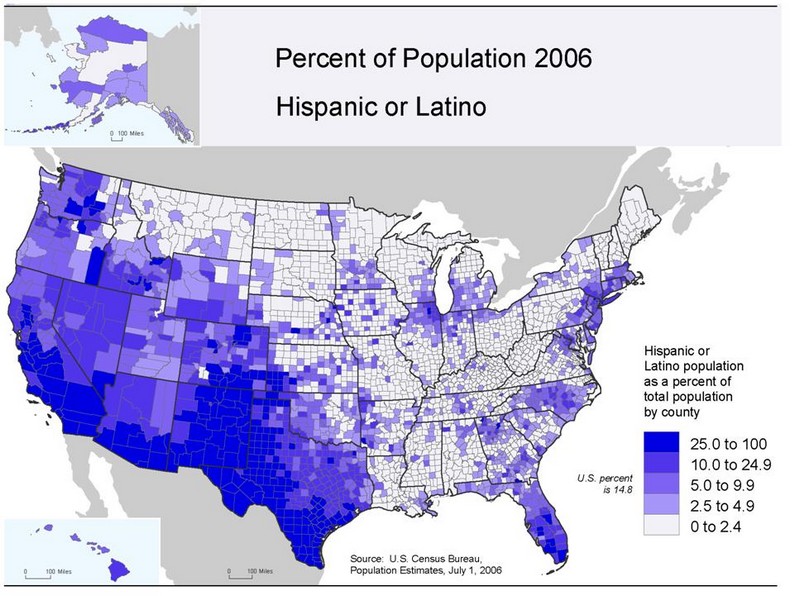
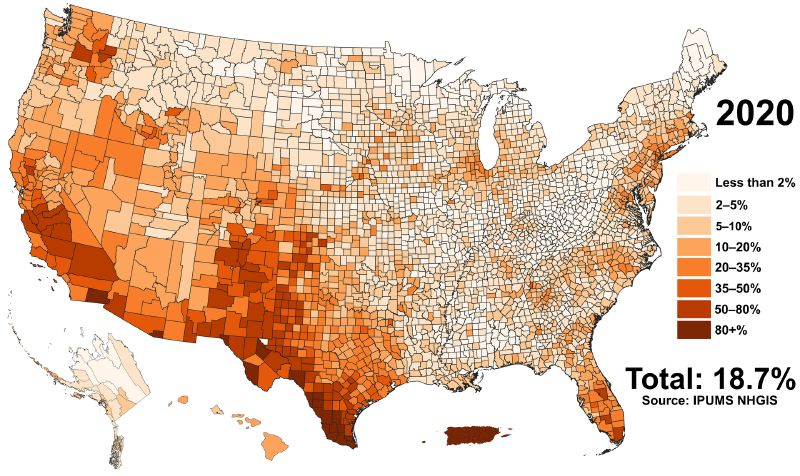
The numbers of Spanish background people has been greatly on the increase in the USA throughout the 20th and into the 21st century. The size of the population with a Latino background is close to 70m. This segment now represents the largest non-anglo ethnic group in the United States, outnumbering the African Americans.
Self-perception of the Chicanos
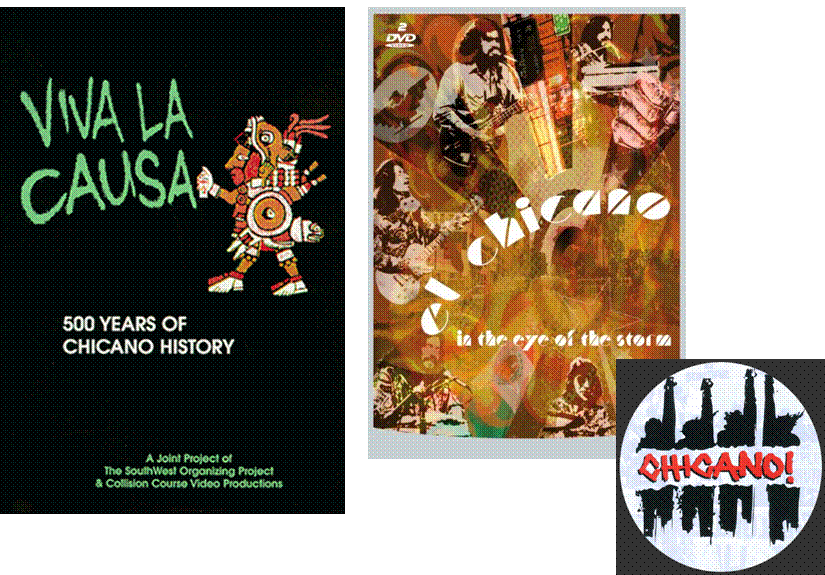
Here is an anonymous posting to a website dedicated to Chicano issues in the USA.
‘I have lots of Chicano friends who speak English, but do not speak Spanish. These persons are monolingual. Yet, many of my monolingual friends choose to mix in words in Spanish. Linguists have documented this as a dialect of English known as Chicano English. Originally people thought that Chicano English wasn’t even a separate dialect of English, that it was just the way that people spoke when their first language was Spanish (“making mistakes”, and with an “accent”). But while Chicano English is influenced by Spanish in a general way, we now know that it is its own separate dialect, not just a “Spanish accent” because there are monolingual English speakers who don’t know any Spanish, and yet still speak Chicano English.’
A linguist’s perspective
“Kids of color and working-class kids,” explains Otto Santa Ana, a linguist at UCLA, grow up speaking “an organic dialect, a language of their community.” Santa Ana has an appointment in the Department of Chicana/o Studies and has written extensively on Chicano English in Los Angeles. He says “there is no linguistic problem” with students who speak any of the various non-standard English variants, which are often mistaken for broken English or for English learned as a second language. It's just that “standard English is a dialect that they acquire.”
Prejudice against non-English speakers?
Linguistic features of Chicano English
Vowel variation
Chicano English speakers merge [æ] and [ɛ], so man and men are homophonous as. [ɪ] and [i:] mergers into [i], so ship and sheep are pronounced like the latter.
Final consonant deletion
Spanish allows only single consonants like [n], [l], [s] or [r] to occur at the end of words. All other single consonants in English would thus be unfamiliar to Chicano English speakers in this environment. This means that words which end in consonant cluster have this simplified, e.g. most becomes ‘mos’; felt becomes ‘fel’, start becomes ‘star’.
Consonant variations
[z] is devoiced in all environments: Examples: [isi] for easy; [wʌs/was] for was.
[v] is devoiced in word-final position: Examples: [lʌf] for love; [hɛf/xɛf] for have; [wajfs] for wives; and [lajfs] for lives.
Chicano speakers may realize /v/ as a [b]: Examples: live [lib], invite [inbait]. TH can be pronounced as a single D or T/S/F, so that that is pronounced [dɛt] and think may be pronounced [tink], [fink] or [sink].
The realization of Y for J [dʒ] and the realization of J for Y, so: joking is [joʊkin], you is [dʒu], jet is [jɛt], just is [jʌs] and, yet is [dʒɛt].
M at the end of a words becomes [n] or [ŋ], so welcome is [wɛlcʌn] or [wɛlcʌŋ]. Words with a G sounding like [dʒ] are pronounced like [ʒ], so: change is [ʃeinʒ]. /tʃ/ merges with /ʃ/, so sheep and cheap are pronounced like [ʃip].
R is pronounced as a flap, so ready is [ſɛdi]
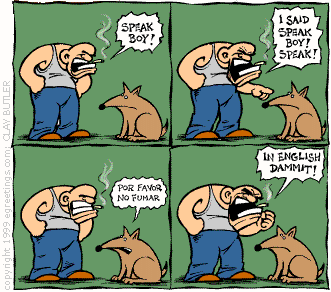
Did you barely call me?
Speakers of Chicano English “maintain solidarity with those linguistic features” which “signal … home and community,”, according to Santa Ana. ‘Their speech gives comfort and promotes camaraderie. It may also employ double negatives and other non-standard forms that are not often welcome at school’.
Chicano English, for example, has some “lexical items” that are specific to the language, according to linguist Carmen Fought in her book Chicano English in Context. The words fool (“dude” or “guy”), kick it (“hang around”), and barely (“just recently”) take on altered senses in the phrase, “Hey fool, don’t you wanna kick it? You barely got here.” Differences in pronunciation may be noticed, for example, in the dropping of “g” from the suffix “-ing” and in intonation, so that the second syllable of “running” sounds more like “een.”
False friends
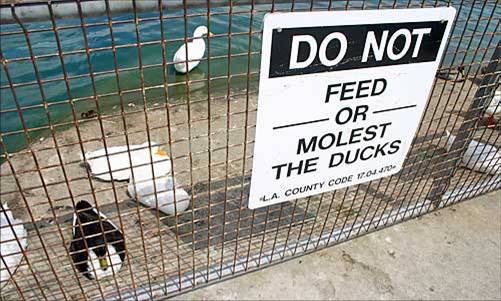
To a native Spanish speaker the English verb “molest” is what linguists call a “false friend.” It sounds like the Spanish verb molestar ‘bother, disturb’, but doesn’t mean exactly the same thing.
Literature on Chicano English
.png)
.jpg)
Bayley, Robert and Otto Santa Ana 2004. ‘Chicano English grammar’. In Bernd Kortmann, Edgar W. Schneider, Kate Burridge, Rajend Mesthrie and Clive Upton (eds.), A Handbook of Varieties of English: Morphology and Syntax. Vol. 2. Berlin: Mouton de Gruyter, pp. 167-183.
Fought, Carmen 2003. Chicano English in context. New York: Palgrave Macmillan.
Ornstein-Galicia, Jacob 1988. Form and Function in Chicano English. Rowley, Mass.: Newbury House Publishers.
Penfield, Joyce 1985. Chicano English: An Ethnic Contact Dialect. Amsterdam: John Benjamins.
Santa Ana, Otto and Bayley, Robert 2004. ‘Chicano English phonology’. In Edgar W. Schneider, Bernd Kortmann, Kate Burridge, Rajend Mesthrie and Clive Upton (eds.), A Handbook of Varieties of English: Phonology. Vol. 1. Berlin: Mouton de Gruyter, pp. 407-424.
Thomas, Erik R. (ed.) 2019. Mexican American English. Substrate Influence and the Birth of an Ethnolect. Cambridge: Cambridge University Press.

Guzzardo-Tamargo, Rosa E. 2026. Puerto Rican English In Natalie Schilling, Derek Denis and Raymond Hickey (eds) The New Cambridge History of the English Language, Vol. 5: North America and the Caribbean. Cambridge: Cambridge University Press, pp. 413-441.
Thomas, Erik R. 2026. The English of Americans of Mexican and Central American Heritage In Natalie Schilling, Derek Denis and Raymond Hickey (eds) The New Cambridge History of the English Language, Vol. 5: North America and the Caribbean. Cambridge: Cambridge University Press, pp. 442-469.
