English in Canada
Historical outline
Linguistic features
Phonology and lexis
Newfoundland
Literature
References

Historical outline


Jacques Cartier (1491-1557) John Cabot (Giovanni Cabote) (c 1450 - c 1499)
John Cabot landed in Newfoundland in 1497 and so began the settlement of Canada by Europeans. Up to this date indigenous tribes peopled the country. Their languages are still extant in small ethnic groups within present-day Canada and their position is similar to that of the native Indians in the United States. The languages of these groups belong to the various language families of the North American continent which pre-date the coming of the Europeans. A special position is occupied by the Inuit (formerly termed Eskimos) in the arctic regions of northern Canada). The name Canada is of uncertain origin.
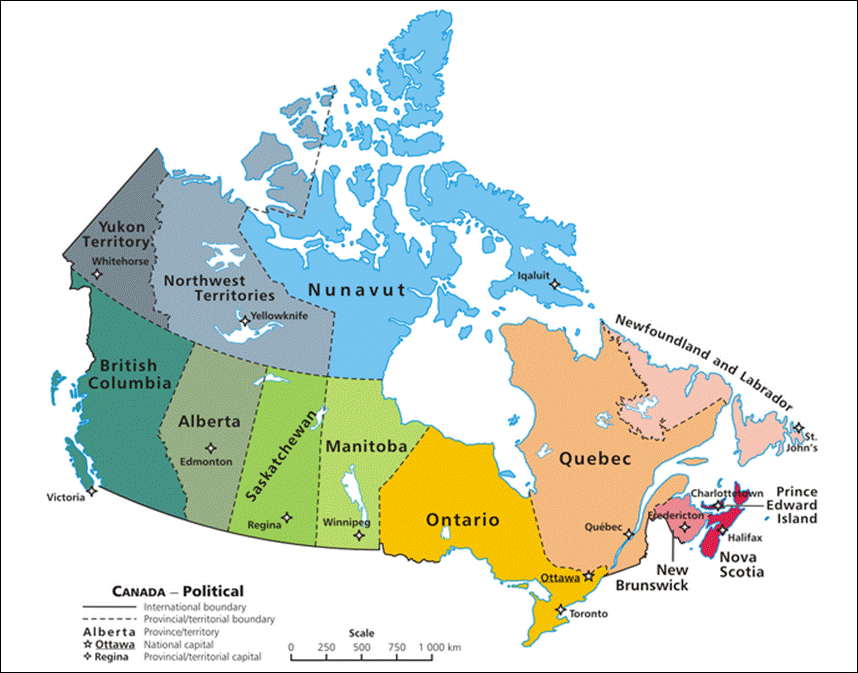
In 1534/35 Jacques Cartier captured the areas of the St. Lawrence river for the French and in 1608 Samuel de Champlain founded Quebec. Up to 1674 the administration of the French colony was a matter of a colonial company (compare the situation with the English in India). After this date the French crown took over the government of French Canada. The Treaty of Utrecht in 1713 established the position of the English in Newfoundland. In 1774 the Quebec Act established the province of Quebec officially. The Americans attempted unsuccessfully in 1775 to take over Quebec. Many loyalist Americans came to Canada after the American Revolutionary War (formerly termed the War of Independence) in 1783 and settled in the province of New Brunswick. Due to early settlement patterns in Canada various centres of population developed. The constitution of 1791 acknowledged this and created two halves in Canada: Upper-Canada (mainly British) and Lower-Canada (mainly French). The Americans tried once again unsuccessfully in 1812-14 to conquer Canada. The necessity to form a unity to oppose America led to the unification of Lower and Upper Canada with the Provinces of Nova Scotia and New Brunswick: the Dominion of Canada was founded on 1.7.1867. Later other minor provinces were added such as those of the Hudson Bay Company (Manitoba, Alberta and Saskatchewan). British Columbia joined in 1871. Canada remained a British colony (subject formally to the British crown) until the beginning of the twentieth century. In 1920 Britain recognised the right of Canada to sign international treaties on its own. At the Empire Conference in 1926 and later with the Statute of Westminster (1931) Canada attained, along with other dominions, formal independence from Britain but remained a member of the loose confederation of states known as the Commonwealth. The Maritime Provinces with Newfoundland had a rather peripheral status until being integrated fully into the Canadian state in the mid-twentieth century (Newfoundland joined in 1949).
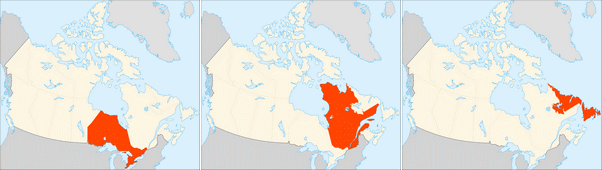
The provinces of Ontario, Québec, Newfoundland & Labrador
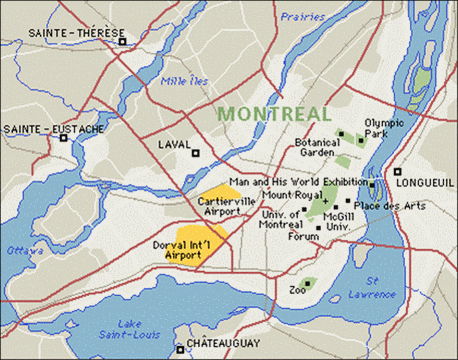
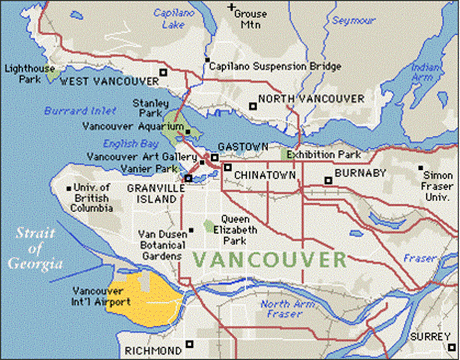
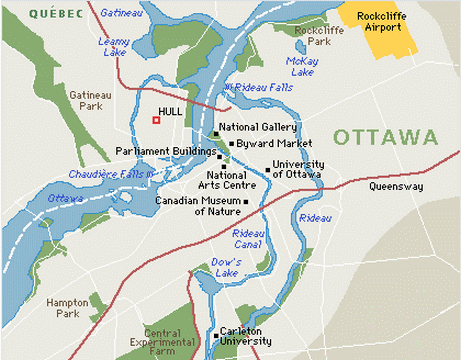
Four of the major cities of Canada: Toronto, Montreal, Vancouver and Ottawa (the national capital).
Main facts Population: c. 41 million inhabitants. Capital: Ottawa. Consists of 10 provinces and three territories. Of these Ontario with over 14 m is the most populous followed by Quebec with 8-9 m. The latter province is French-speaking as opposed to the remaining provinces. Canada is the second largest country in the world. Official languages: French and English. Most Canadians are the descendants of English-speaking immigrants (44.6%) or of French immigrants (28.7%). However, other ethnic groups are also represented such as Ukrainians (2.7%), Italians (3.4%), Germans (6.1%), Dutch (2%) and Poles (1.5%).

In terms of language input from Britain and Ireland the small group of Scottish immigrants in Cape Breton in Nova Scotia, who have maintained a variety of Scots Gaelic to this day, are significant as are the English-derived and the Irish-derived populations of Newfoundland. The area of the Ottawa Valley retained features of the original Irish settlers into the twentieth century, e.g. the perfective aspect I’m after washing the car, ‘I have just washed the car’, but these have since given way to more general features of Canadian English.

Main linguistic features
Canadian English can be said to occupy an approximate position between American and British English. This can be explained historically, seeing as how Canada was under the influence of Britain for very much longer. Furthermore, the Canadians do not like to be mistaken for Americans and so they may avoid salient traits of English in the United States. Despite its great size there is not much variation within Canadian English. What variation there is, in traditional Anglo-Canadian speech, tends to be found on the eastern coast, above all in Newfoundland, the area first settled by people from the British Isles.
Phonology
The main feature is what is called Canadian Raising by which is meant that the diphthongs /ai, au/ are pronounced as /əɪ, ʊə/ before voiceless consonants and /ai, au/ before voiced ones, e.g. knife /nəɪf/ : knives /naɪvz/; house /hʊəs/ : houses /haʊzɪz/. /æ/ is raised somewhat to /ɛ/ (as in AmE.); /ɔ/ is unrounded to /ɑ/: stop /stɑp/. Canadian English is known for the COT-CAUGHT merger, e.g. Don and dawn are pronounced the same.
Lexis
The lexis of Canadian English contains many elements from native American languages, those of the First Nations, such as kayak ‘canoe of Greenlander’; parka ‘skin jacket with hood attached’. The much quoted interjection eh? is supposed to be a shibboleth for Canadians but tends to be avoided because of its all too obvious character.
Newfoundland
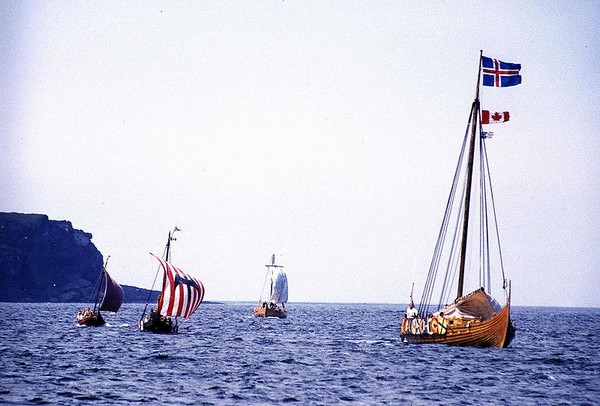
Newfoundland was first visited by the Vikings under Leif Eriksson in about 1,000 CE. It was (re)discovered in 1497 by John Cabot, seeking like Columbus before him, a short route to Asia. Newfoundland was later formally annexed for Britain by Sir Humphrey Gilbert in 1583.
The economic value of Newfoundland for the British lay in the abundant cod stock in the fishing grounds off the south-east coast known as ‘The Grand Banks’. These are the source for the Irish name for Newfoundland: Talamh an Éisc ‘Ground of Fish’
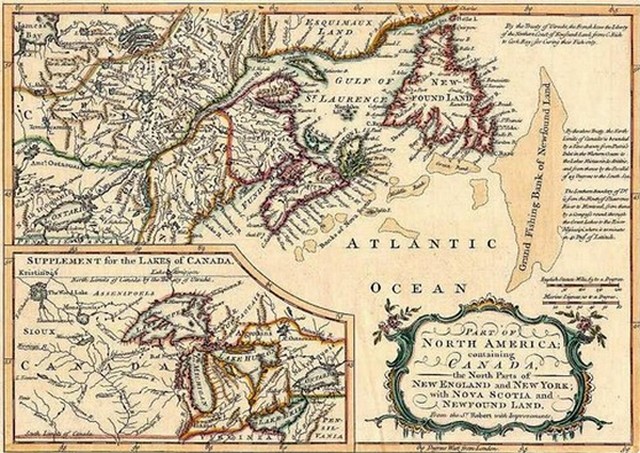
Newfoundland is the oldest English colony in Canada. It was settled at least two centuries before the United Province of Canada was set up in 1841 with the Dominion of Canada following in 1867. The province was independent until it decided by a narrow majority to join the Canadian Federation in 1949, after having experienced considerable economic difficulties (with technical bankruptcy in 1934) and direct administration by Britain until shortly after the Second World War.
Newfoundland has a history of seasonal migration from Ireland and the West Country of Britain: Workers came over in the summer to partake in the fish industry and returned in the winter and so there was - up until the 19th century - a continuous input of dialect features from the two areas just mentioned and many aspects of Newfoundland English can be accounted for given the Irish and West Country backgrounds of its original settlers.
N.B. ‘Newfoundland’ is pronounced with stress on the last syllable, as are other toponyms of the region such as ‘Labrador’, ‘Carbonear’, etc.
.gif)


Literature on Canadian English
.jpg)
.gif)