


Australia
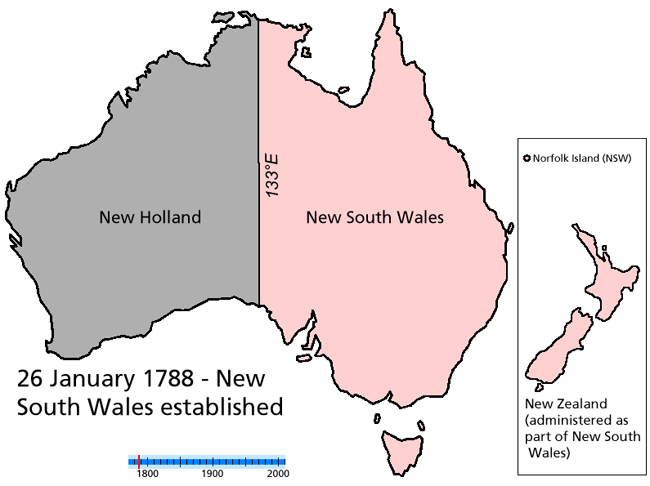


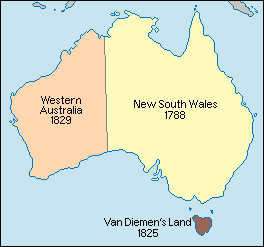
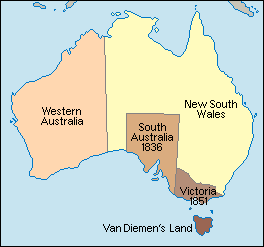
Historical outline Australia, the southern land, has known three colonial periods. The first is the brief one of the Spanish, remarkable by simply involving the initial discovery of Australia by de Quirós in 1606. The Spanish did not however follow up the matter with an expedition.
Almost at the same time as the Spanish a Dutch expedition under Willem Jansz arrived at the Torres Strait at approximately the same time as Luis de Torres himself. In 1611 some Dutch ships sailing eastward from the Cape of Good Hope reached west Australia. In 1626-7 a further expedition came under Abel Tasman after whom the name of Tasmania, the large island off the south west coast of Australia is named (formerly Van Diemens Land). Tasman also explored New Zealand. An expedition in 1644 explored north Australia.
The British In 1688 William Dampier explored north east Australia; in 1699-1700 he explored further, both times writing an exhaustive account of his journeys. British involvement in Australia really got underway with James Cook who, in three major explorations in 1768-1770, 1772-1775 and 1776-1779, firmly established Australia as an object of colonial interest. In the last two decades of the 18th century some more explorations by the French and English were undertaken, colonisation began in earnest at this time.
Originally Australia was used as a release for the overcrowded British prisons, for example the First Fleet in 1787 sailed with 730 convicts on board, some 250 free persons also sailed. Britain established several penal colonies and by the first quarter of the 19th century most of coastal Australia had been settled by the British. By 1830 an estimated 58,000 convicts had been settled.
The Great Shift from 1830 to 1860 saw the rise of Australia with its agricultural and mining economy, the formation of four of Australia’s six states and the beginning of the period of non-convict settlers (often political or religious dissidents from England). The economy centred mainly around the production of wool and grain on the one hand and the exploitation of Australia’s mineral resources on the other hand (copper, nickel, etc.). For a time in the late 19th century gold and silver mining was important. The infrastructure of Australia was greatly improved by the construction of railways in the 1880’s. In 1901 the Federation of Australia (consisting of the following states: Victoria, New South Wales, Queensland, Western Australia, Southern Australia and the island Tasmania) was formed. Today Australia is independent but still a member of the British Commonwealth.
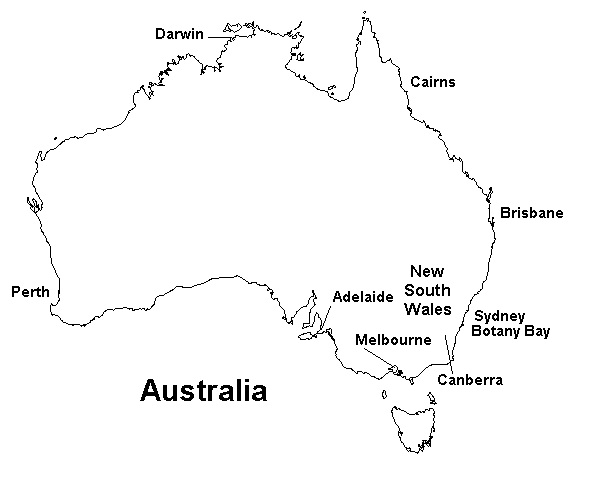
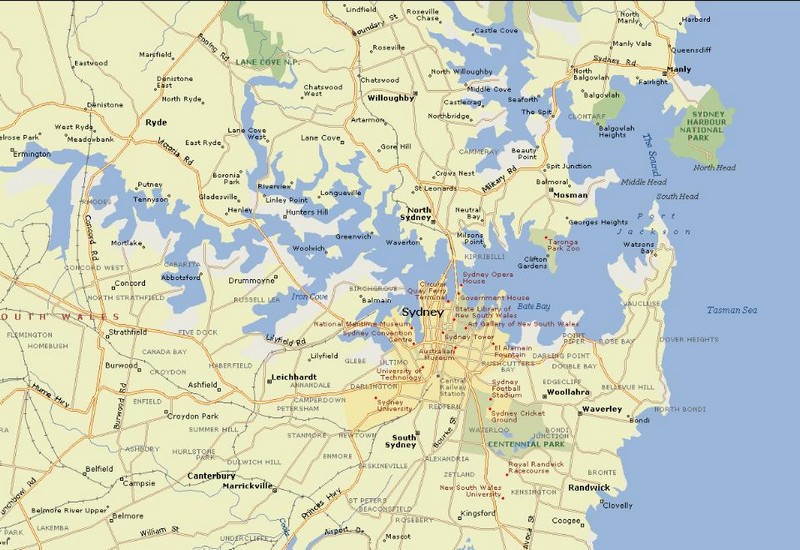
Australia has an area of 7,682,300 sq km and a population of 13.5 m. The capital is Canberra, the two largest cities, Sydney and Melbourne both have a population of nearly 3 m. The official language is English, a large variety of native languages are spoken in small quantities by the aborigines (native Australians).
The white population derives traditionally from Irish or English immigrants and is known as ‘Anglo-Celtic’. In the present century immigration from other European countries took place, e.g. from Greece and Italy. Furthermore, Australia feels the proximity to major Asiatic neighbours like China. The following description applies to General Australian English.

Main linguistic features
Phonology Long vowels and diphthongs differ considerably from British English but form a coherent system. Centralisation of vowel beginning beat /bəɪ/, boot /bəʊt/. Retraction or advancing of initial element: high /hʌɪ/, how /æʊ/. Lowering of initial element: say /sʌɪ/, so /sʌʊ/. Short front vowels are noticeably raised: man [mɛn], men [men], something which is common to South African and New Zealand English.
Morphology Many compounds are formed with typical first elements, e.g. bush as in bushfire, bushman or the last element cocky as in sheepcocky. Many meanings are derived from the components which are used to form compounds, e.g. outback (from out and back); weekender (from ‘to spend a weekend in a country house’); New Zealand has the form bach (from ‘to live as a bachelor’).
Lexis Many words are loans from aborigine languages, e.g. boomerang, kangaroo, koala, gin (slang for woman); in some instances AusE. has older forms not used in BrE., e.g. couth whereas BrE. only has uncouth.
Map of routes taken for the transportation of settlers in the late 18th and 19th centuries

Literature on Australian English
.gif)
.png)