


African American Diaspora
Relevance of diaspora
Internal migration
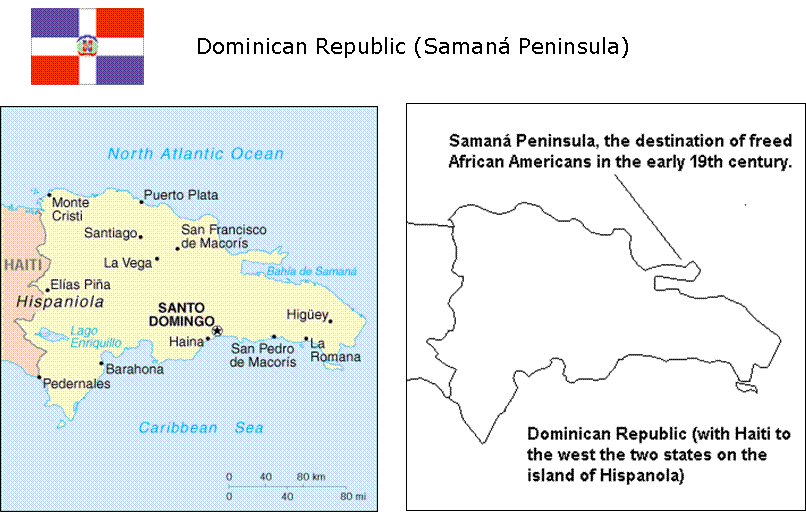
The island of Hispaniola is divided into two parts, the western one is Haiti, a country where a French creole is spoken. The eastern part is the Dominican Republic where Spanish is spoken.
A number of African Americans settled on the tip of the Samaná Peninsula in the north-east of the country during the 19th century and many of these continued to speak their variety of English. Because it is cut off from the North American mainland, Samaná African American English shows archaic features not found in varieties on the US mainland.
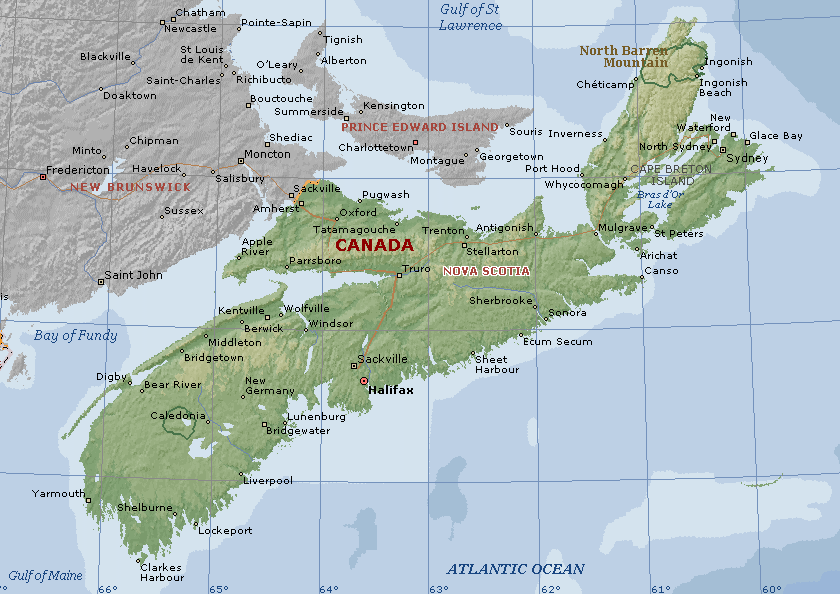
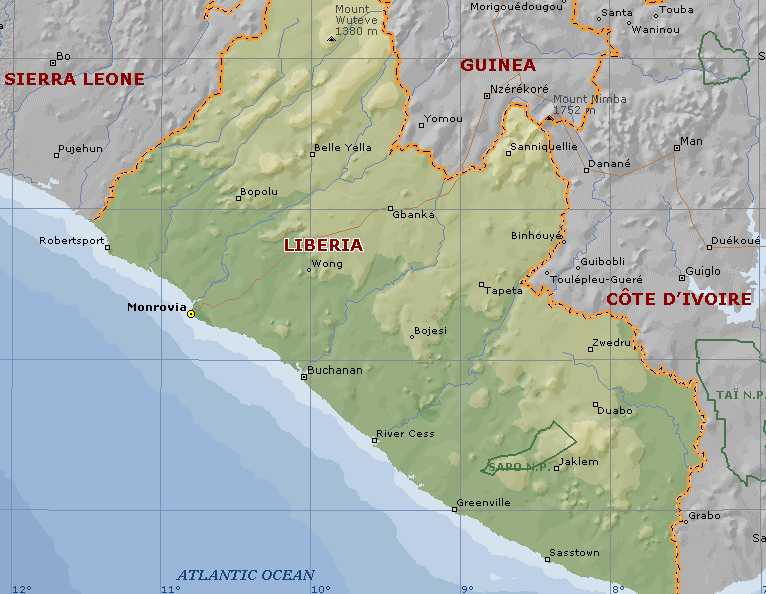
By the beginning of the nineteenth century there were movements afoot to free slaves and to offer them the opportunity of repatriation to West Africa. One of these led to the foundation of Liberia which was proclaimed a republic in 1847. Another location for repatriated African Americans was Freetown in Sierra Leone. Again in the early nineteenth century, some African Americans settled on the Samaná Peninsula in the Dominican Republic as just mentioned. The African Americans in Nova Scotia in eastern Canada stem from a few thousand who left the United States between 1783 and 1785 as a result of the American Revolution. The locations of these African American diaspora communities are indicated on the following map.

The relevance of the diaspora to present-day African American English
The diaspora were cut off from the main group of African Americans at the time of their dispersion. The assumption of linguistis is their language then ceased to share in the development of AAE in the core settlement areas.
By examining the features of diaspora forms of AAE one can reach conclusions about the nature of AAE in the early 19th century.
For example, the diphthong flattening which is typical of AAE in the southern United States today is not generally found in disapora forms (on Samaná or in Nova Scotia). The assumption is then that this is a recent development, going back to the late 19th century at the earliest.
Diphthong flattening: life = /la:f/, wife /wa:f/, time = /ta:m/, etc.
Internal migration
At the end of the nineteenth and in the early twentieth century large numbers of African Americans from the South migrated northwards to the cities of the North-East, North and Midwest to gain employment in the new urban industries which had a great need for manual labour, above all the automobile industry in cities like Detroit. Among the migrants from south to north were also poor whites in search of work. This migration, and later movements out of the South, led to concentrations of blacks in large cities and led to urban variaties of African American English arising.
.gif)
.jpg)
Anderson, Bridget L. 2008. Migration, Accommodation and Language Change: Language at the intersection of regional and ethnic identity. Basingstoke: Palgrave Macmillan.
Poplack, Shana and Sali Tagliamonte 2001. African American English in the diaspora. Oxford: Blackwell.
