English in Africa
English in Africa by region
English in Africa by type
West Africa
Gambia
Sierra Leone
Liberia
Ghana
Nigeria
Cameroon
East Africa
Languages of Africa
References
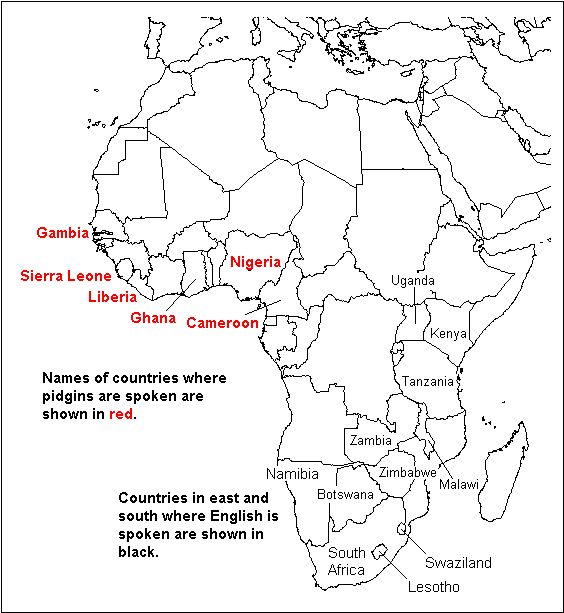
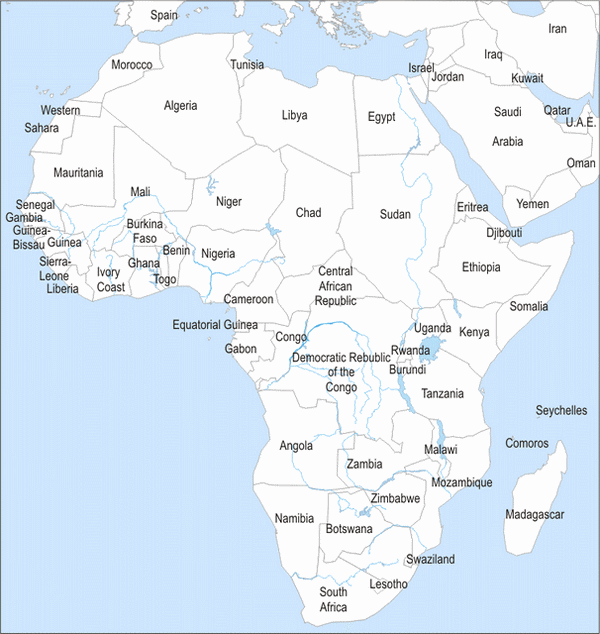
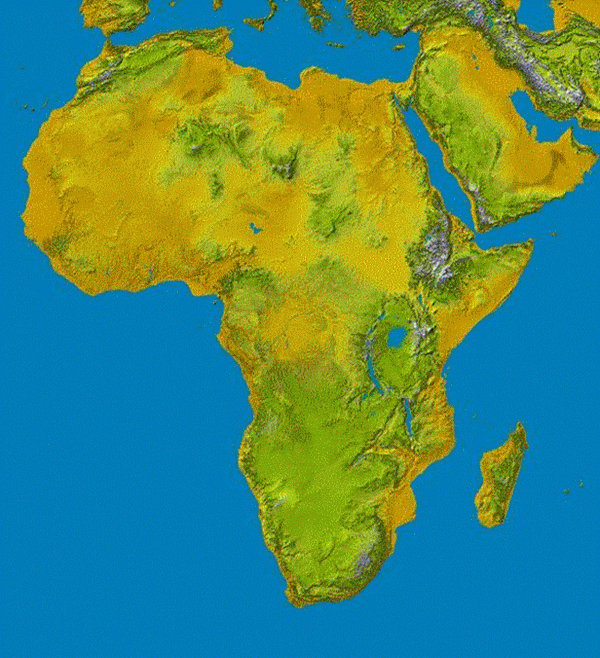

Africa has a long and complicated colonial history. The west coast was first visited by the Portuguese and as of the 17th century. With the development of the slave trade and the discovery of the trade route to India via the Cape of Good Hope, the continent came increasingly to feel colonial pressure from England, France and Holland as major European maritime powers. This development reached its peak in the 19th century with the Scramble for Africa when the interior of the continent was carved up by the Europeans, usually with no regard for the demographic distribution of the indigenous peoples.
Thus the Belgians took a huge part of equatorial Africa and called it Belgian Congo (it was later known as Zaire is now called the (Democratic) Republic of the Congo during its turbulent post-independence history). The Portuguese took Angola and the British lands on the east and west coasts such as Kenya, Uganda and Nigeria, Sierra Leone respectively. What was later to become the Republic of South Africa shows an early Dutch and a later English influence. German presence was to be found above all in South-West Africa, present-day Namibia (up until the end of WWI). Some countries, such as Cameroon, have had different periods under different colonial powers, in this case the British, the French and (for a short while) the Germans.
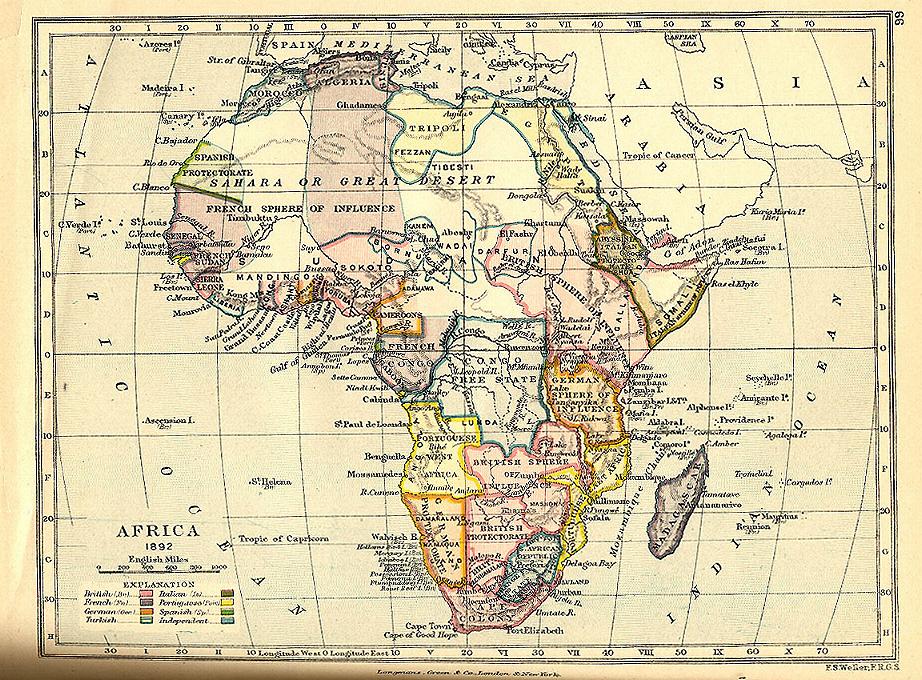
The majority of African countries succeeded in gaining their independence from the European powers during the latter part of the 20th century. The roads to independence have been different for different countries. The British relinquished their colonies fairly easily, e.g. Nigeria, less so Rhodesia (present-day Zimbabwe). Most other European powers were involved in some kind of struggle in the process: the French were tied up in a war of independence in Algeria. The Italians in Abyssinia and later the Belgians in the Congo were engaged in military conflict during their retreat from their colonies while the Portuguese loss of Angola was due largely to turbulences in the mother country.
West Africa
1: English in Cameroon
2: English in Nigeria
3: English in Ghana
4: English in Liberia
5: English in Sierra Leone
East Africa
English in Tanzania, Kenya and Uganda
Southern Africa
(distinguish South Africa - a country - and Southern Africa - a region)
1: Language in South Africa, 1: South African English
2: Language in South Africa, 2: Afrikaans English
3: Language in South Africa, 3: South African Indian English
4: Language in South Africa, 4: Black South African English
English in Africa by type
Supraregional / lingua franca
New Englishes in Africa: Pan-African features
(East Africa, the north of Southern Africa: Namibia, Botswana, Zimbabwe, Zambia)
Black South African English
Swahili on east African coast
Pidgins and creoles
West Africa: Sierra Leone, Ghana, Nigeria, Cameroon
Transportation, re-settled English
African American English: the African connection
Liberia, partially Sierra Leone
Native forms of English (settler English)
South African English, Zimbabwe (white population)
Contact forms of English
Afrikaans English
Cameroon English (contact with French)
South African Indian English
English in West Africa

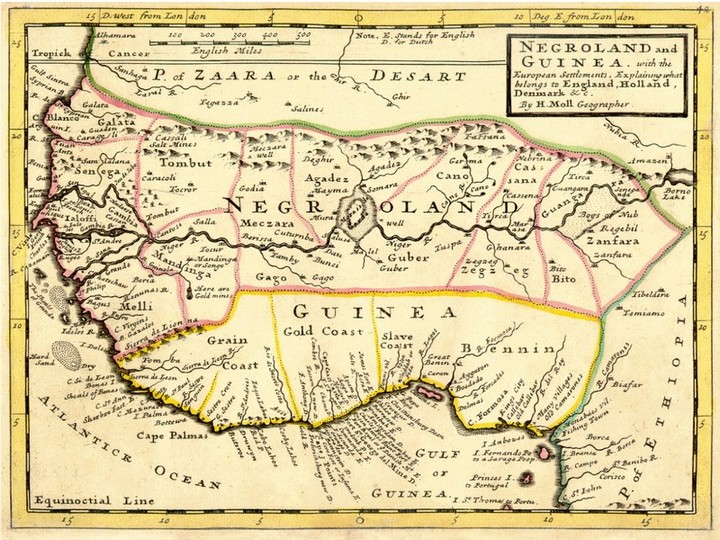
The term ‘West Africa’ is used to refer to the set of nations on the coast of western Africa from Gambia (in the north-west) and Cameroon (in the south-east). Nearly all of them are former colonies of England (hence the official language of many of them is English) and the base for the pidgins spoken in this region is English. Note that West Africa is used to refer to the maritime states of western Africa. It is here of course that trade contacts were most intensive from the beginning of colonial times onwards and thus pidgins developed to a greater degree here than in other parts of Africa. The Republic of South Africa in the extreme south of the continent shows the interaction of English and Dutch in colonial times, which resulted in the language Afrikaans, which is in many respects a pidginised form of Dutch. The following are the main countries in the West African group.
Gambia
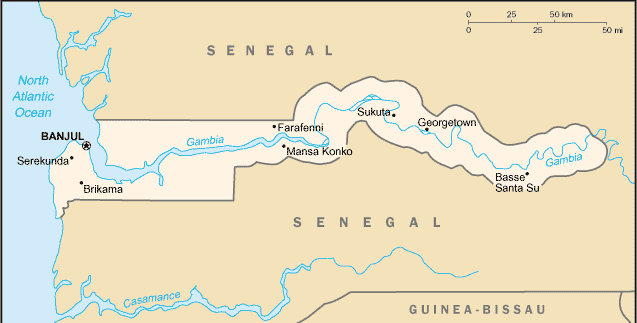
Republic; independent since 1965; area: 11,300 sq km; pop: 2.7 m.; capital: Banjul. Contacts with Britain exist since the late 16th century. It was a separate colony after 1843 but with close ties to Sierra Leone. The pidgin of Gambia is Aku which is closely related to Krio (see below). The main indigenous language is Wolof (a West African language).
Sierra Leone
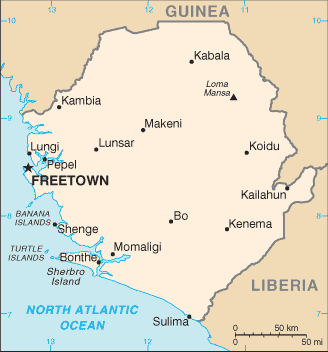
Republic; independent since 1961; area: 71,400 sq km; pop: 8.6 m.; capital: Freetown. The first colonials were Portuguese, later (end of 16th century) the British arrived setting up a trading post. A British colony since 1808, the capital was populated in the early 19th century by ex-slaves who returned after military service for the British. The creole here is called Krio and arose on the basis of the native pidgin of the region. Nowadays Krio is used as a creole in Freetown.
Liberia
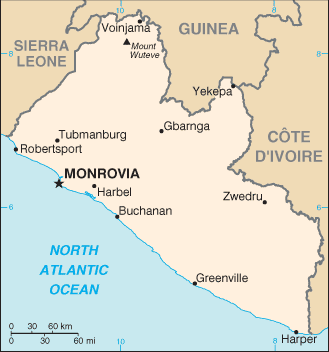
Republic, founded in 1847; area: 111,370 sq km; pop: 5.6 m.; capital: Monrovia. Established as a settlement for ex-slaves from the United States. Independent of the United States since 1867. American influence is to be seen in the English of Liberia (the pidgin is called Merico) which has features in common with African American Vernacular English dialects of the United States. Apart from Merico there is a further pidgin called Kru spoken by the tribe of the same name. Some Krio is also spoken (originating from Sierra Leone).
Ghana
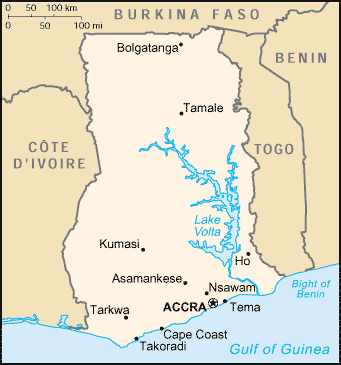
Republic; independent since 1957 (old name: Gold Coast); area: 238,500 sq km; pop: 34 m.; capital: Accra. Again a British settlement dating from the late 16th/early 17th century. There is no specific name for the pidgin spoken in Ghana; additionally English is spoken as a second language by many speakers as opposed to a pidginised form of English used. The neighbouring country of Togo (area: 56,000 sq km; pop: 9.5 m.; capital: Lomé) has pidginised English alongside English as a second (i.e. foreign) language for many of its inhabitants).
Nigeria
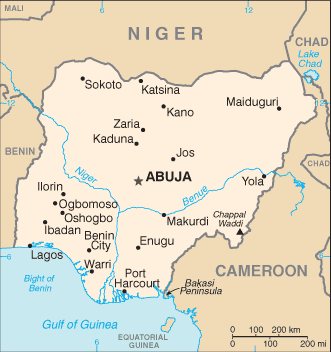
Republic; independent since 1960; area: 923,700 sq km; pop: 233 m.; capital: Lagos. Nigeria consists of a federation of separate regions based on tribal affiliations (the main ethnic groups are those of the Yoruba and Igbo who both speak languages of the same name). English has been spoken since the early 17th century (alongside native pidgin English) and is used on official or semi-official occasions. The position of English is particularly strong given the enormous diversity of native languages found in Nigeria.
Cameroon
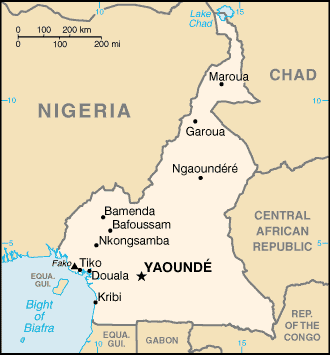
Republic; independent since 1960; area: 475,000 sq km; pop: 29 m.; capital: Jaunde. Like much of the rest of coastal west Africa, Cameroon was British in practice since the end of the sixteenth century. However, the country was annexed by Germany in 1884 and declared a German Protectorate. After the First World War the country was divided among the French and British to the advantage of the former. For this reason both English and French are official languages in present-day Cameroon, which is geographically based on former French Cameroon, most of former British Cameroon having gone to Nigeria (in the north). The English pidgin, which bears no specific name, is estimated to be spoken by between a quarter and a fifth of the population in many official spheres much as in Nigeria.
East Africa
This is a large area encompassing Uganda, Kenya and Tanzania. The position of English is somewhat different from that in southern and west Africa as here an indigenous lingua franca, Swahili, has been spoke for centuries. English is used as a supplementary language and not a primary pidginised one as was the case in West Africa for many speakers. e.g. in a country like Nigeria with many mutually unintelligible indigenous languages.
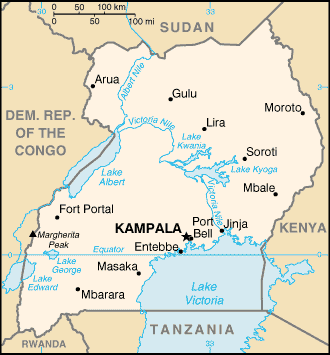
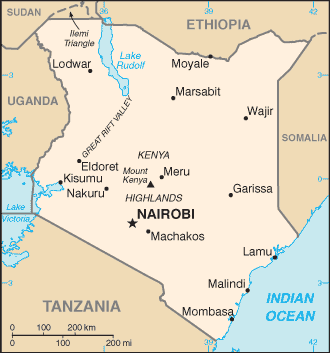
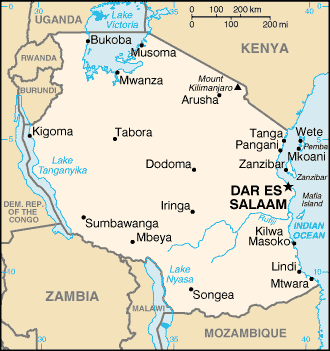
Because the native languages of eastern Africa frequently belong to the Bantu group there is in many countries a common Bantu substrate. Furthermore, English interacts with Swahili in this region so that code-switching and mixed forms result. In general one can say that East African English is non-rhotic and has a simplified vowel system with frequent syllable-timing, an item of transfer from the Bantu substrate (this also holds for varieties of Black English in South Africa, Botswana, Zimbabwe, Malawi and Zambia, for instance.
English in Southern Africa
It is important to distinguish between South Africa - a country, officially called the Republic of South Africa - and Southern Africa - a region which consists of various countries. First of all, South Africa, with the enclave Lesotho and the partial enclase Eswatini (former Swaziland), and then the English-speaking countries Zimbabwe, Zambia, Malawi and Botswana. English is also used in Namibia, former South-West Africa.
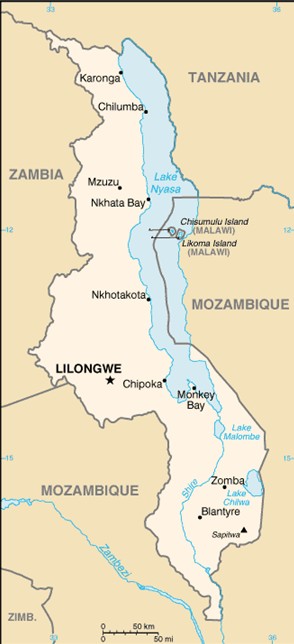
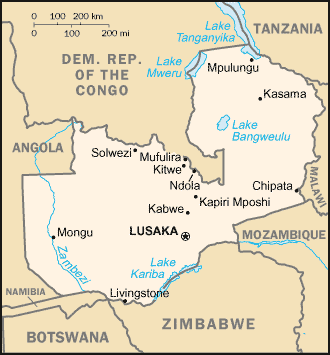
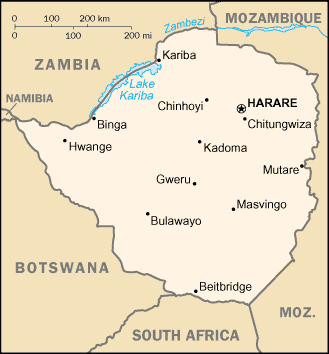
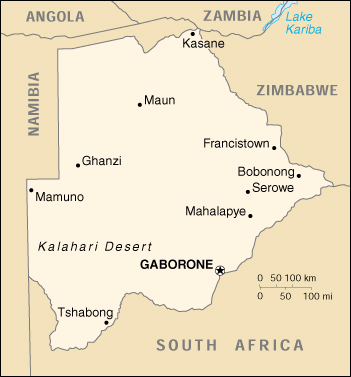
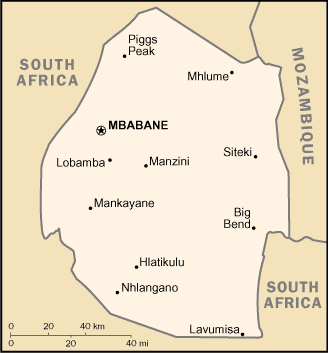
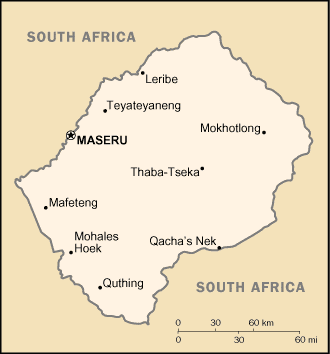
The English language was first brought to South Africa at the end of the 18th century. It spread northwards during the 19th century with the colonial exploration and exploitation of present-day Zimbabwe and Zambia (former Southern and Northern Rhodesia respectively), especially by Cecil Rhodes. The area on the left of Lake Nyasa (in present-day Malawi) was affected by this and partly anglicised. This was also true of Bechuanaland (present-day Botswana) which resisted incorporation into South Africa. The area of present-day Namibia came under German control later in the 19th century but was also affected by the spread of the English language (and Afrikaans) from South Africa. Mozambique remained a dependency of Portugal (until 1975) and did not come within the sphere of English.
The main language groups in Africa

Brato, Thorsten 2026. English in Ghana. In Raymond Hickey (ed.) The New Cambridge History of the English Language, Vol. 6: Africa, Asia, Australasia and the Pacific. Cambridge: Cambridge University Press, pp. 237-261.
Buschfeld, Sarah 2026. English in Namibia. In Raymond Hickey (ed.) The New Cambridge History of the English Language, Vol. 6: Africa, Asia, Australasia and the Pacific. Cambridge: Cambridge University Press, pp. 521-546.
FitzMaurice, Susan 2026. English in Zimbabwe. In Raymond Hickey (ed.) The New Cambridge History of the English Language, Vol. 6: Africa, Asia, Australasia and the Pacific. Cambridge: Cambridge University Press, pp. 547-580.
Gut, Ulrike and Foluke Unuabonah 2026. English in Nigeria. In Raymond Hickey (ed.) The New Cambridge History of the English Language, Vol. 6: Africa, Asia, Australasia and the Pacific. Cambridge: Cambridge University Press, pp. 262-292.
Meierkord, Christiane, Bebwa Isingoma and Anne Marie Kagwesage 2026. English in Uganda, Rwanda, Burundi, the Democratic Republic of Congo and South Sudan. In Raymond Hickey (ed.) The New Cambridge History of the English Language, Vol. 6: Africa, Asia, Australasia and the Pacific. Cambridge: Cambridge University Press, pp. 355-382.
Schmied, Josef 2026. English in Kenya and Tanzania. In Raymond Hickey (ed.) The New Cambridge History of the English Language, Vol. 6: Africa, Asia, Australasia and the Pacific. Cambridge: Cambridge University Press, pp. 327-354.
Singler, John Victor 2026. English in Liberia. In Raymond Hickey (ed.) The New Cambridge History of the English Language, Vol. 6: Africa, Asia, Australasia and the Pacific. Cambridge: Cambridge University Press, pp. 207-236.
Wolf, Hans-Georg and Eric Anchimbe 2026. English in Cameroon. In Raymond Hickey (ed.) The New Cambridge History of the English Language, Vol. 6: Africa, Asia, Australasia and the Pacific. Cambridge: Cambridge University Press, pp. 293-325.
Yakpo, Kofi, Saidu Bangura and Malcolm Awadajin Finney 2026. English and Krio in Sierra Leone. In Raymond Hickey (ed.) The New Cambridge History of the English Language, Vol. 6: Africa, Asia, Australasia and the Pacific. Cambridge: Cambridge University Press, pp. 175-206.