


Pragmatic markers
Politeness / Impoliteness
Terms of address
Adverbials
References
Historical pragmatics
.jpg)
.jpg)
.jpg)
.jpg)
Pragmatic markers
By ‘pragmatic markers’ are understood linguistic items (lexical words or grammatical particles) which have a propositional meaning and an additional one with which they can be employed to structure a discourse while not exhibiting their literal meanings. Already in Old English (c. 450-1100) some items can be recognised which appear to have this dual function, e.g. hwæt ‘what’or þa ‘then, when’. Because the textual record for Old English does not clearly represent the colloquial spoken language of the time, it is difficult to identify pragmatic markers unambiguously and scholars disagree on their interpretations of the data and on their use of linguistic terminology in this field.
This is situation persists into the Middle English period (1100-1500) the situation improves given the attestation of vernacular language in various literary works, most notably in the Canterbury Tales by Geoffrey Chaucer (1343-1400) with its many depictions of everyday life and characters in fourteenth-century England.
Politeness / Impoliteness
.jpg)
.jpg)
One of the areas most intensively researched within the broader context of pragmatics is that of politeness and it has been implied that norms shifted over the centuried within English. For Old English, scholars have assumed (see Kohnen 2008) that the value of preserving face was not as important as obligation and loyalty to one's kin and to the principles of the Christian church. A further shift would have taken place in the Middle English period with the French-influenced practice of courtly politeness. For both periods scholars assume that there existed formulaic speech acts with distinct pragmatic functions (Jucker 2020, 2025) which shifted with changes in social conventions in English society over time, above all with the rise of individualism and negative forms of politeness used for face-saving in various interpersonal encounters.
The mirror image of politeness is, of course, impoliteness and this too has been the object of linguistic research (see Culpeper 2011; Culpeper et al. eds, 2017). Some impoliteness devices are formulaic, these include swearing, cursing and insulting others, but also language employed inappropriately to a given context as with an unexpected use of an address term (see next section).
.gif)
The investigation of address terms has enjoyed a certain popularity among linguists concerned with pragmatics. These terms are easy to recognise and delimit: normally there is a binary choice between two alternatives rendering interpretations relative easy. Here as elsewhere, periods of transition are linguistically most interesting: the loss of a specific second-person singular pronoun – thou – and the use of you to address one or more persons is one of the major grammatical and pragmatic changes of the early modern period in English. With Shakespeare, as in the play Richard III, one can see how using thou when addressing someone can be disrespectful (as it can in many modern European languages if used inappropriately). This connotation of disrespect, indeed contempt, is thought to be a major reason when thou fell out of fashion, remaining only in prayers and poetry and in some regionals form of English such as rural Yorkshire dialect.
Note that the loss of a distinction between singular and plural in the second person led to many non-standard forms of English retaining or indeed developing additional forms to realise a formal distinction in number for second person pronouns (Hickey 2003).
See the section morphological change for more details.
.jpg)
An adverb is, as the name implies, an item which accompanies a verb and modifies its meaning in a certain direction, e.g. She walked slowly out of the room. They discussed the matter quietly while sitting together. But such items can also occur in absolute position, at the beginning of a sentence. The term ‘adverbials’ can be used to capture this more general usage, i.e. one not confined to a strictly verb-qualifying setting.
Sentence-initial elements generally characterise a discourse in some manner, e.g. Admittedly, he’s not the best student I’ve ever had, or may serve to link what a speaker is saying to what has just gone before, usually as spoken by the speaker, e.g. That said, I’d still bet my money on the conservatives winning. What’s more, he won’t be coming to the meeting tomorrow either.
One of the key functions of adverbs/adverbials is intensification: the items in question add force to a statement or reduce its force, i.e. intensifiers can go in either direction. Those which increase the force are labelled ‘boosters’ and those which reduced it are called ‘downtoners’. Because words in general, and adverbs in particular, lose their ‘punch’ with consistent use in a speech community, new intensifiers continuously arise to add an element of emphasis to one’s speech. Those which lose this intensifying function fall by the wayside and ultimately disappear from a language. This may also happen for broader social reasons. In many western-style societies intensifiers based on religious usage tend to disappear, or have done so already, as have many intensifiers or metaphors which derive from militarary usage being often replaced by sports-based expressions, e.g. a level playing field, shifting the goalposts, kick in from the sideline, etc.
Boosters: That is so not happening. It’s terribly irresponsible to leave like that. That was a fantastic meal. His behaviour was totally out of character.
Downtoners: She scarcely acknowledged his help in the matter. We barely made the plane in time. That mountain is sort of difficult to climb.
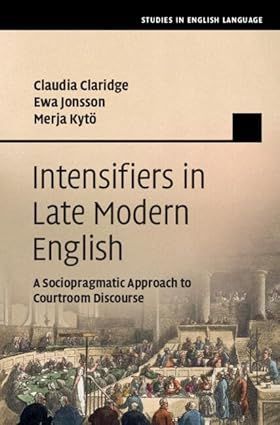
Note that the above distinction is an initial binary one; there are many subtypes of boosters and downtoners which are discussed in the relevant literature, see Claridge, Jonsson and Kytö (2024) as a recent example.

References

Brinton, Laurel J. 2025. The Development of Pragmatic Markers: Pathways and Processes. In Joan C. Beal (ed.) The New Cambridge History of the English Language, Vol. 3: Transmission, Change or Ideology. Cambridge: Cambridge University Press, pp. 598-628.
Jucker, Andreas 2025. Historical pragmatics. In Laura Wright and Raymond Hickey (eds) The New Cambridge History of the English Language, Vol. 1: Context, Contact and Development. Cambridge: Cambridge University Press, pp. 666-719.
 For further literature on pragmatics please consult the relevant section of the Reference Guide
Aijmer, Karin and Christoph Rühlemann (eds.) 2014. Corpus Pragmatics. A Handbook. Cambridge: Cambridge University Press.
Ariel, Mira 2010. Defining Pragmatics. Cambridge: Cambridge University Press.
Brinton, Laurel J. 1996. Pragmatic Markers in English. Grammaticalization and Discourse Functions. Berlin: Mouton de Gruyter.
Brinton, Laurel J. 2023. Pragmatic in the History of English. Cambridge: Cambridge University Press.
Brinton, Laurel J. 2017. The Evolution of Pragmatic Markers in English. Pathways of Change. Cambridge: Cambridge University Press.
Chapman, Siobhan 2011. Pragmatics. Houndmills, Basingstoke: Palgrave Macmillan.
Claridge, Claudia, Ewa Jonsson and Merja Kytö 2024. Intensifiers in Late Modern English. A Sociopragmatic Approach to Courtroom Discourse. Cambridge: Cambridge University Press.
Couper-Kuhlen, Elizabeth and Margret Selting 2018. Interactional Linguistics: Studying Language in Social Interaction. Cambridge: Cambridge University Press.
Culpeper, Jonathan 2011. Impoliteness. Using Language to Cause Offence. Cambridge: Cambridge University Press.
Culpeper, Jonathan and Michael Haugh 2014. Pragmatics and the English Language. Basingstoke: Palgrave Macmillan.
Culpeper, Jonathan, Michael Haugh and Dániel Z. Kádár (eds) 2017. The Palgrave Handbook of Linguistic (Im)politeness. Basingstoke: Palgrave Macmillan.
Cummins, Chris 2019. Pragmatics. Edinburgh: Edinburgh University Press.
D’Arcy, Alexandra 2017. Discourse-Pragmatic Variation in Context. Eight Hundred Years of LIKE. Amsterdam: John Benjamins.
Fitzmaurice, Susan M. and Irma Taavitsainen (eds) 2007. Methods in Historical Pragmatics. Berlin: Mouton de Gruyter.
Furkó, Péter B. 2020. Discourse Markers and Beyond. Descriptive and Critical Perspectives on Discourse-Pragmatic Devices across Genres and Languages. Basingstoke: Palgrave Macmillan.
Heine, Bernd, Gunther Kaltenböck, Tania Kuteva and Haiping Long 2020. On the Rise of Discourse Markers. Cambridge: Cambridge University Press.
Huang, Yan 2015. (ed.), The Oxford Handbook of Pragmatics. Oxford: Oxford University Press.
Jucker, Andreas 2020. Politeness in the History of English. From the Middle Ages to the Present Day. Cambridge: Cambridge University Press.
Jucker, Andreas 2025. Historical pragmatics. In Laura Wright and Raymond Hickey (eds) The New Cambridge History of the English Language, Vol. 1: Context, Contact and Development. Cambridge: Cambridge University Press, pp. 666-719.
Jucker, Andreas (ed) 1995. Historical pragmatics. Pragmatics developments in the history of English. Amsterdam: John Benjamins.
Jucker, Andreas, Gerd Fritz and Franz Lebsanft (eds) 2000. Historical dialogue analysis. Amsterdam: John Benjamins.
Jucker, Andreas H. and Irma Taavitsainen (eds) 2008. Speech Acts in the History of English. Amsterdam: John Benjamins.
Jucker, Andreas H. and Irma Taavitsainen 2020. Manners, Norms and Transgressions in the History of English: Literary and linguistic approaches. Amsterdam: John Benjamins.
Jucker, Andreas H., Daniela Landert, Annina Seiler and Nicole Studer-Joho 2013. Meaning in the History of English: Words and texts in context. Amsterdam: John Benjamins.
Kohnen, Thomas 2008. Linguistic politeness in Anglo-Saxon England?: A study of Old English address terms. Journal of Historical Pragmatics 9.1:140-158.
Landert, Daniela 2024. Methods in Historical Corpus Pragmatics: Epistemic Stance in Early Modern English. Cambridge: Cambridge University Press.
Leech, Geoffrey N. 1983. Principles of Pragmatics. London: Longman.
Leech, Geoffrey N. 2014. The Pragmatics of Politeness. Oxford: Oxford University Press.
Lutzky, Ursula 2012. Discourse Markers in Early Modern English. Amsterdam: John Benjamins.
O’Keeffe, Anne, Brian Clancy and Svenja Adolphs 2020. Introducing Pragmatics in Use. London: Routledge.
Schiffrin, Deborah 1987. Discourse Markers. Cambridge: Cambridge University Press.
Taavitsainen, Irma and Andreas H. Jucker (eds) 2003. Diachronic perspectives on address term systems. Amsterdam: John Benjamins.
Traugott, Elizabeth Closs 2022. Discourse Structuring Markers in English: A historical constructionalist perspective on pragmatics. Amsterdam: John Benjamins.
Xie, Chaoqun, Francisco Yus and Hartmut Haberland (eds) 2021. Approaches to Internet Pragmatics. Amsterdam: John Benjamins.