


United States, African American English
African American Vernacular English, AAVE for short, is the form of English traditionally spoken by the descendants of black African slaves in the southern United States and found in many urban centres throughout the United States. There are two views on its origin: (1) it is a de-creolised form of an earlier creole which had developed on the cotton plantations of the south, (2) it is basically a dialect of English with a combination of features not found elsewhere. It may well, of course, be a mixture of these sources.
There are a number of salient features of African American Vernacular English. In phonology one could mention the r-lessness, seen in car [ka:] and party [pa:ti], the reduction of word final clusters, as in test [tes] and desk [des], the deletion of /l/ in final clusters, e.g. help [hep], the shift of interdental fricatives to stops, e.g. this [ḏɪs], there [ḏɛ:]. In word-final position /θ/, /ð/ is frequently shifted to [f], [v](as in Cockney English), e.g. bath [ba:f], teeth [ti:f], brother [brʌvə].
In the area of grammar one finds multiple negation, e.g. I ain’t goin’ to give nothin’ to nobody. Existential there can be replaced by it: It ain’t no football pitch at school. The genitive is not necessarily marked with /s/ (as position is sufficient to indicate this category): I drove my brother car. In syntax one finds such features as the omission of third person singular -s: She like my brother The copula is deleted in so-called equative sentences, i.e. those of the form X = Y: She a teacher. They workers in the factory. Like to has often the meaning of ‘almost’: She like to fell out the window. ‘She almost fell out of the window.’
Uninflected be functions as a marker of the habitual aspect: They be out on the street at night. ’They are always out on the street at night.’ A stressed form of been occurs to indicate the remote past: I ˡbeen travel to New York. ’I travelled to New York a long time ago.’ An intentional aspect is found with the particle a, which precedes the verb form: I’m a gonna meet her. ‘I’m about to meet her.’ The unstressed past participle form of do, done [dən], is used to signal an action which has just occurred: The mirror done broke. ‘The mirror has just broken.’
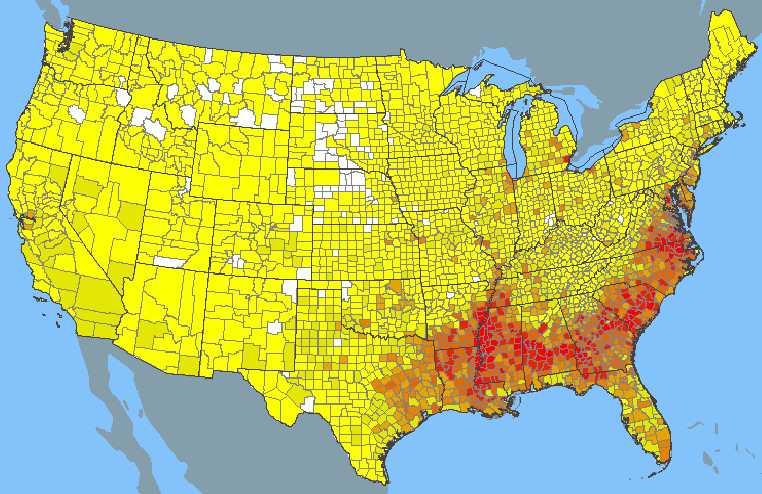
Distribution of African Americans in the United States
 Sample sound file